Master the essentials of Commodity Trading and Risk Management systems
Understanding Commodity Trading and Risk Management Systems
CTRM (Commodity Trading and Risk Management) systems are comprehensive software platforms designed to manage the entire commodity trading lifecycle, from trade capture to risk management and settlement across multiple commodity types.
Modern CTRM systems handle multiple commodities including crude oil, natural gas, metals, agricultural products, and financial derivatives, providing real-time visibility into trading positions and risk exposure.
Complete Trading Workflow from Initiation to Settlement
The commodity trade lifecycle encompasses all stages from trade initiation through final settlement. CTRM systems streamline these processes to ensure accuracy, efficiency, and regulatory compliance.
Effective trade lifecycle management requires real-time data, accurate position tracking, and robust controls. Modern CTRM systems automate many processes while maintaining proper oversight capabilities.
Advanced Position Tracking and Risk Analysis Techniques
Position and exposure management are critical for effective commodity trading. CTRM systems provide sophisticated tools to track positions, analyze exposure, and manage risk across multiple commodities and markets.
Successful position management requires accurate real-time data, robust valuation methods, and comprehensive reporting. Modern CTRM systems provide these capabilities while ensuring regulatory compliance.
A CTRM (Commodity Trading and Risk Management) system is the core platform that supports the entire commodity trading lifecycle. Its architecture defines how different functional modules such as trading, risk management, logistics, settlement, invoicing, accounting, and reporting are structured and connected within a single, integrated environment.
The architecture is designed to ensure seamless data flow from front office to back office. Trades captured by traders flow automatically into risk calculations, logistics execution, settlement processing, and financial reporting without manual re-entry. CTRM systems also integrate with external systems such as exchanges, clearing houses, market data providers, ERP systems, and regulatory platforms.
A well-designed CTRM architecture is scalable and flexible, allowing organizations to add new commodities, markets, or regulatory requirements over time. It provides a single source of truth, ensuring data consistency, transparency, and control across the organization.
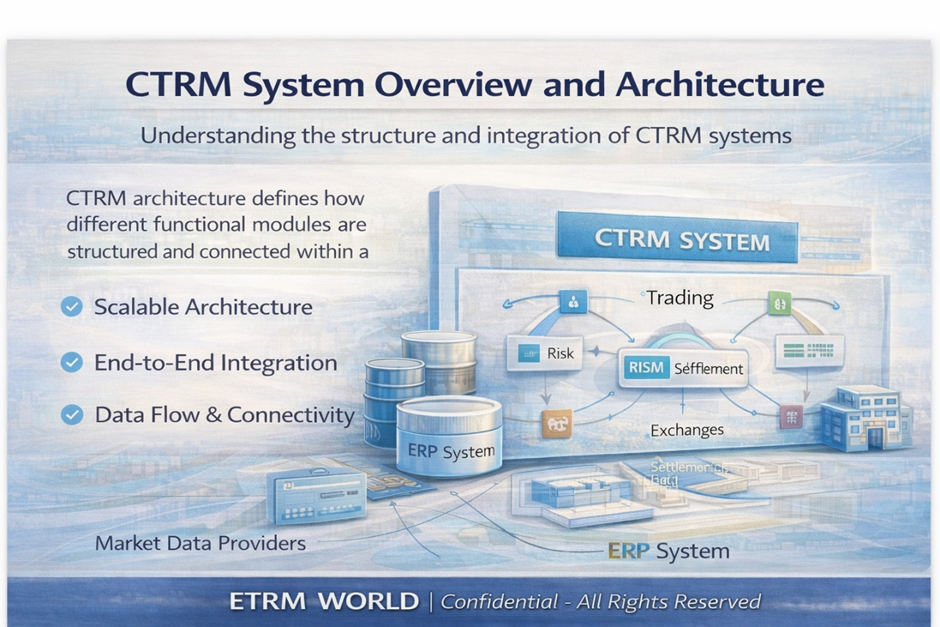
CTRM System Overview
Trade capture, pricing, market data integration
Risk management, position keeping, analytics
Settlement, invoicing, accounting, reporting
External systems, exchanges, ERP connectivity
© 2026 ETRM World Powerd By 3DGLOBAL. All rights reserved.
Commodity market fundamentals explain how and why commodity prices move. They provide the economic and physical context needed to understand trading decisions and risk exposure. These fundamentals are driven by supply and demand dynamics, production capacity, consumption patterns, inventory levels, weather conditions, geopolitical events, and macroeconomic factors.
Markets operate through different structures such as spot markets, where commodities are bought and sold for immediate delivery, and forward or futures markets, where prices are agreed today for future delivery. Pricing benchmarks, seasonality, and regional differences also play a major role in commodity valuation.
Understanding these fundamentals helps traders, analysts, and risk managers anticipate market movements, design effective trading strategies, and manage volatility. Without this foundation, it is difficult to interpret price signals or assess risk accurately.
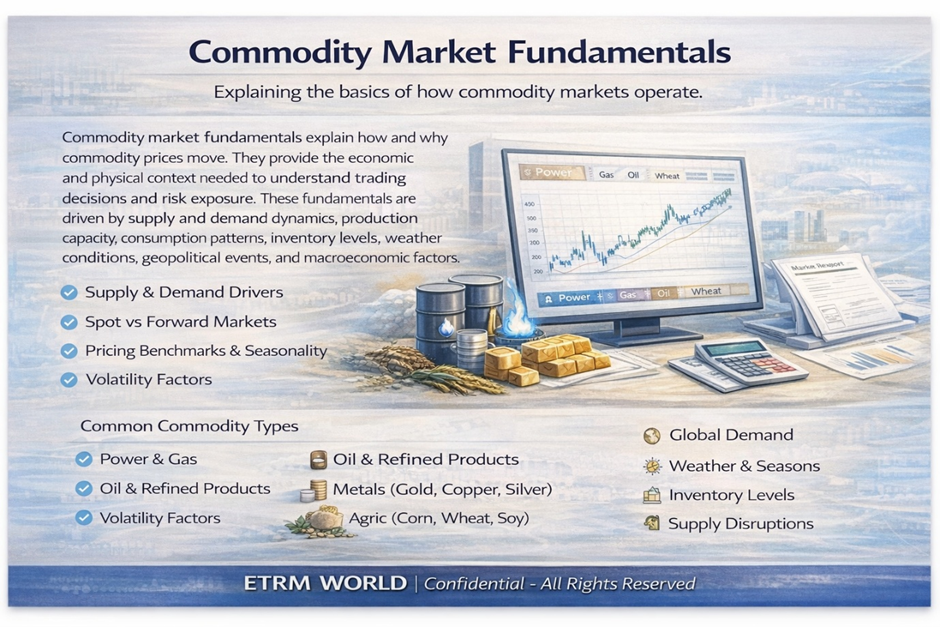
Commodity Market Fundamentals
Immediate delivery and settlement
Future delivery at agreed prices
Customized future contracts
Rights but not obligations
© 2026 ETRM World Powerd By 3DGLOBAL. All rights reserved.
Trading workflows define the end-to-end lifecycle of a trade, from execution to final financial settlement. The process typically starts with trade execution and capture, followed by validation, risk assessment, confirmation, scheduling, settlement, invoicing, and accounting.
Each step involves different teams across the front, middle, and back office. Front office focuses on deal execution, middle office manages risk and controls, and back-office handles settlement and finance. A well-defined workflow ensures that responsibilities are clearly separated while information flows smoothly between teams.
Standardized trading workflows reduce operational risk, improve efficiency, and ensure compliance with internal policies and external regulations. They also enable automation, reducing manual errors and speeding up trade processing cycles.
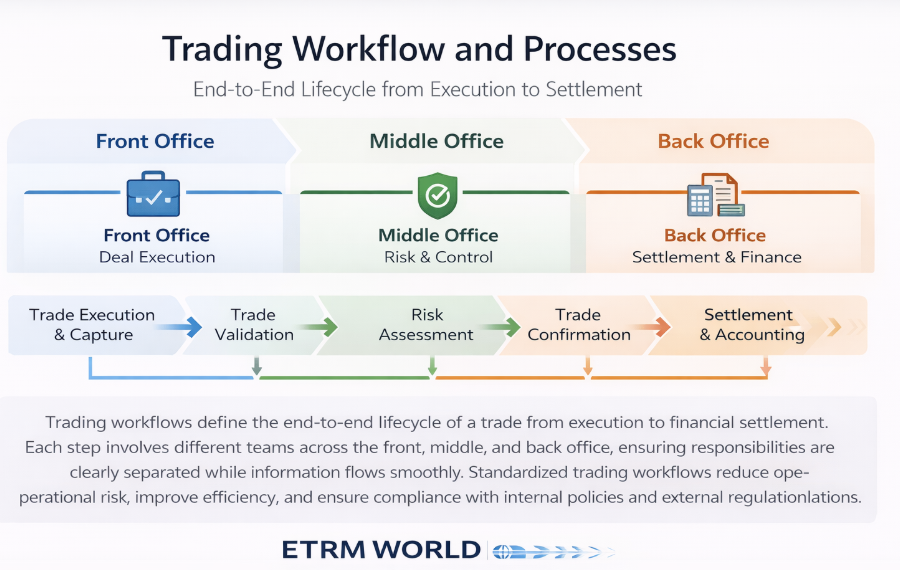
Trading Workflow and Processes
Trade execution, deal capture, pricing
Risk management, controls, validation
Settlement, invoicing, accounting
Legal, compliance, IT support
© 2026 ETRM World Powerd By 3DGLOBAL. All rights reserved.
A CTRM system consists of multiple core components, including trade capture, risk management, position management, logistics and scheduling, settlement, invoicing, accounting, and reporting. Each component plays a specific role but operates as part of an integrated platform.
Integration is critical for CTRM success. The system connects with external platforms such as exchanges for price feeds, clearing houses for margin and settlement data, transmission operators for scheduling, terminals for inventory updates, and ERP systems for financial postings.
Strong integration ensures real-time data availability, operational efficiency, and accurate reporting. It eliminates data silos and allows organizations to respond quickly to market changes, operational issues, or regulatory requirements.
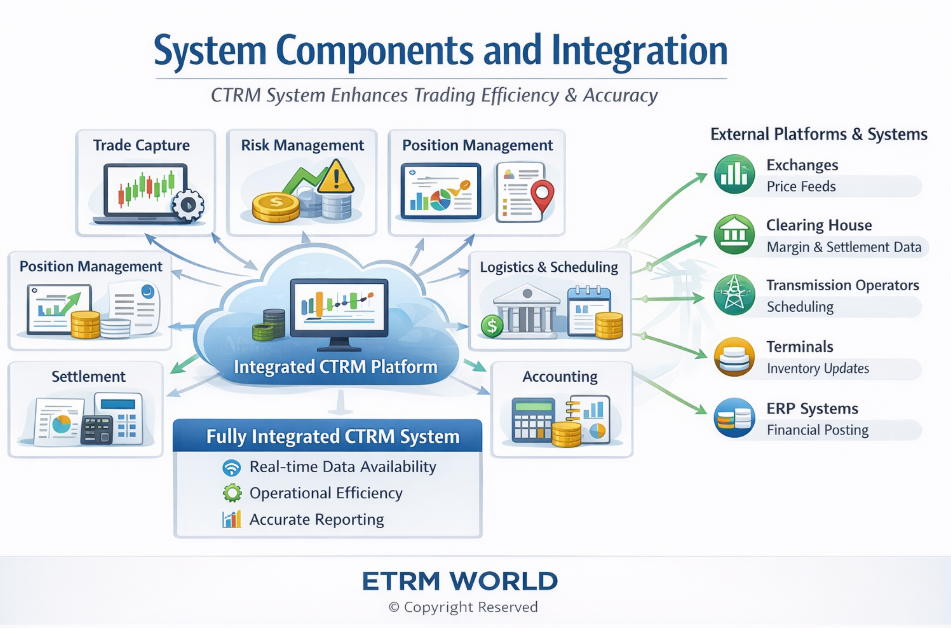
System Components and Integration
Deal entry, validation, recording
VaR, limits, exposure analysis
Real-time position tracking
Transport, storage, delivery
Payment processing, clearing
Financial posting, analytics
© 2026 ETRM World Powerd By 3DGLOBAL. All rights reserved.
Industry standards and best practices guide how commodity trading organizations operate safely, efficiently, and compliantly. These include regulatory requirements, accounting standards, risk management frameworks, operational controls, and audit guidelines.
Best practices emphasize strong governance, segregation of duties, audit trails, risk limits, and transparent reporting. They also promote standardized processes, consistent data management, and automation where possible.
Following industry standards helps organizations reduce regulatory and operational risk, improve credibility with counterparties and regulators, and maintain audit readiness. It also supports long-term scalability and sustainability in increasingly complex and regulated markets.

Industry Standards and Best Practices
FERC, CFTC, ESMA, MiFID II
IFRS, GAAP, hedge accounting
ISO 31000, COSO, Basel III
SOX, internal controls, segregation
© 2026 ETRM World Powerd By 3DGLOBAL. All rights reserved.
CTRM and ETRM systems share many functional similarities but differ in scope and specialization. CTRM systems are designed to support trading across multiple commodity classes, such as energy, metals, agriculture, and soft commodities. They provide broad functionality that can be configured for different markets.
ETRM (Energy Trading and Risk Management) systems are specialized for energy markets, including power, gas, oil, LNG, and renewables. They place stronger emphasis on physical delivery, scheduling, nominations, grid constraints, and energy-specific regulations.
Understanding the difference helps organizations choose the right solution based on their commodity focus, operational complexity, and regulatory environment.
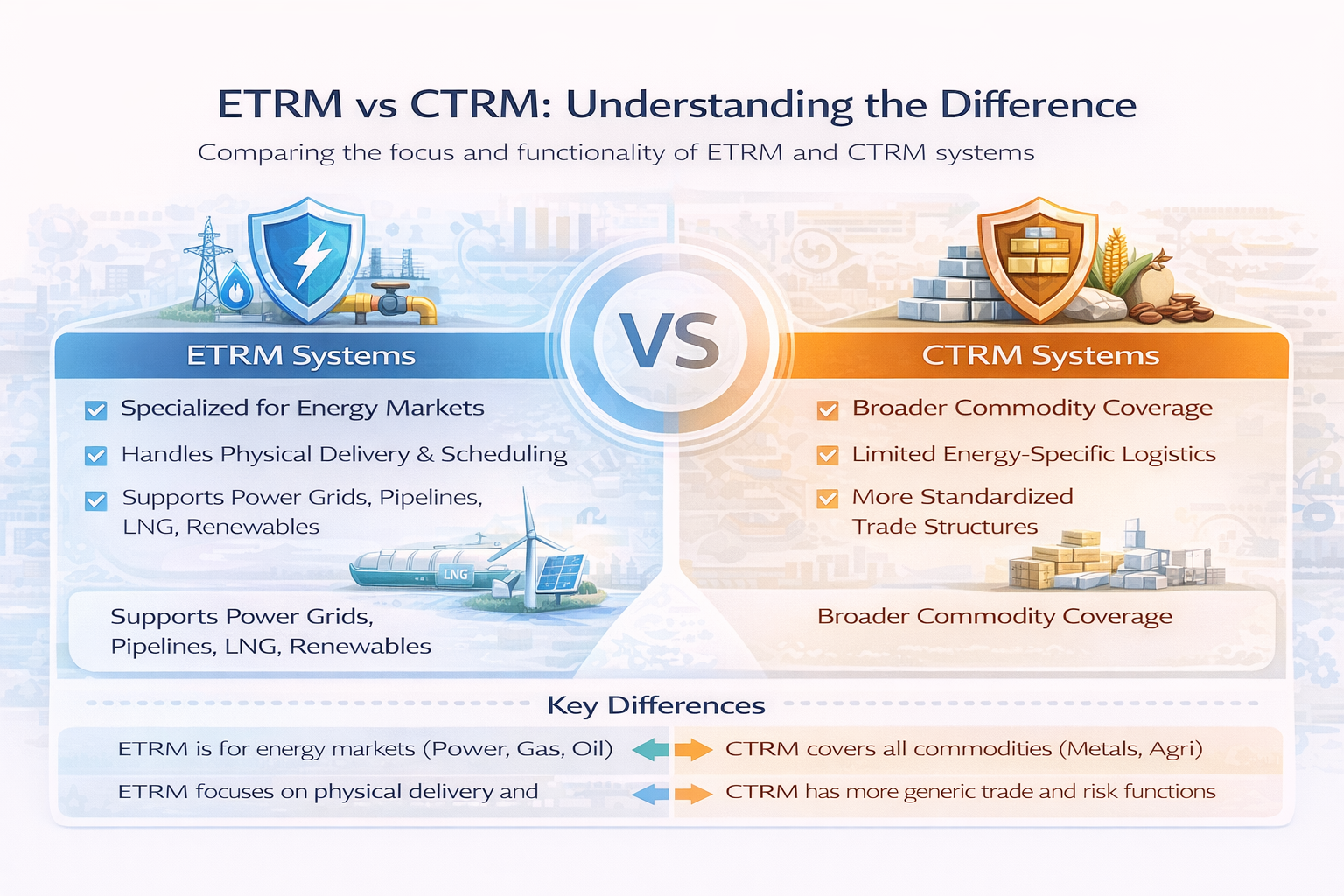
CTRM vs ETRM Comparison
| Feature | CTRM | ETRM |
|---|---|---|
| Multi-Commodity Support | ||
| Physical Scheduling | ||
| Grid Constraints | ||
| Nominations | ||
| Energy Regulations | ||
| Flexibility |
© 2026 ETRM World Powerd By 3DGLOBAL. All rights reserved.
Trade initiation is the foundational stage of the commodity trade lifecycle, where a trading opportunity is identified and formally executed.
At this stage, traders assess market conditions such as supply-demand dynamics, geopolitical factors, seasonal trends, and price volatility. Based on this analysis, they decide whether to buy or sell a commodity through exchanges or over-the-counter (OTC) markets. Once the trade is executed, all relevant trade details are captured into the trading system.
Key trade attributes include commodity type, quantity, quality specifications, price, trade date, delivery location, delivery period, counterparty information, and contractual terms. Accurate and timely trade capture is essential, as errors at this stage can lead to downstream operational issues, financial losses, or compliance breaches.
A valid trade is executed and accurately recorded in trading systems, forming the basis for all subsequent processes.
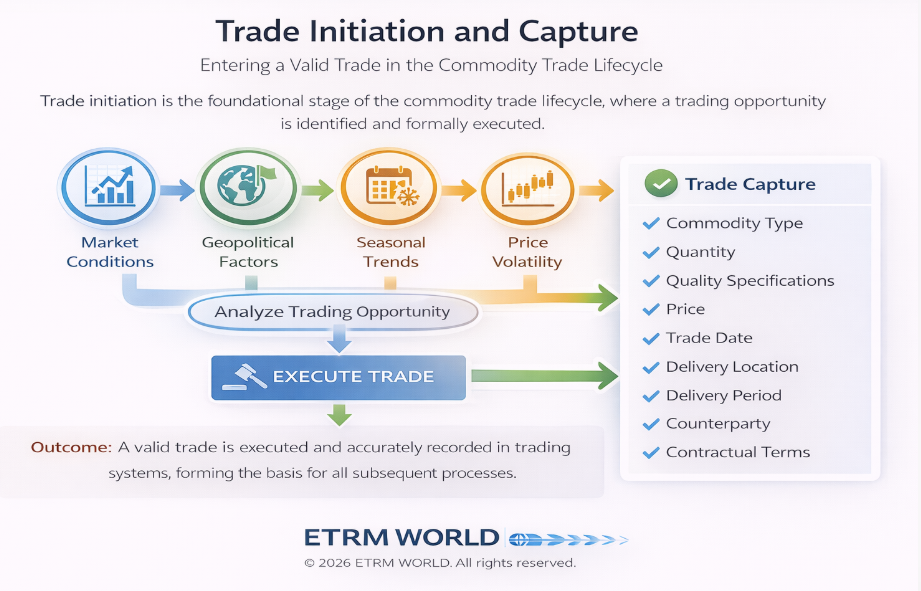
Trade Initiation and Capture
Market balance, inventory levels, production capacity
Political stability, trade policies, sanctions
Weather patterns, demand cycles, harvest seasons
Market sentiment, speculation, price movements
© 2026 ETRM World Powerd By 3DGLOBAL. All rights reserved.
Following trade capture, the transaction moves into the confirmation and validation phase to ensure data integrity and contractual accuracy.
During this stage, trade details are matched between internal systems and counterparty confirmations. This process verifies that both parties agree on pricing, volumes, delivery terms, settlement conditions, and contractual obligations. Any discrepancies identified such as mismatched quantities or pricing are investigated and resolved promptly.
In addition, compliance checks are performed to ensure the trade adheres to regulatory requirements, internal risk limits, and credit policies. Counterparty credit exposure is reviewed to confirm that the trade falls within approved limits.
A fully confirmed and validated trade, reducing the risk of disputes, financial mismatches, and regulatory non-compliance.
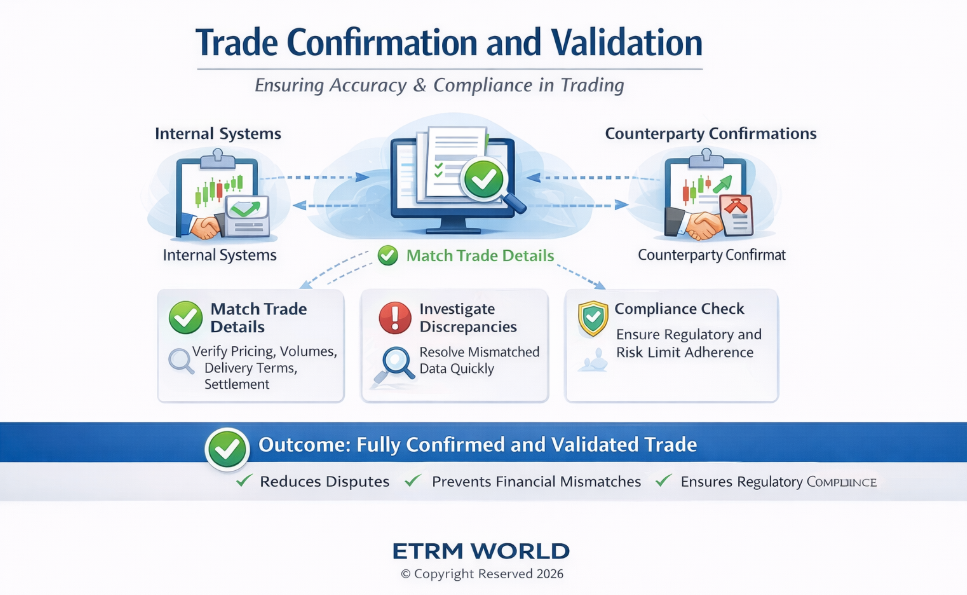
Trade Confirmation and Validation
Internal vs counterparty trade details
Price, currency, pricing mechanism validation
Quantity, quality, delivery terms verification
Payment conditions, settlement date validation
© 2026 ETRM World Powerd By 3DGLOBAL. All rights reserved.
Position management plays a critical role in maintaining visibility over open commodity exposures throughout the trade lifecycle.
Once a trade is confirmed, it contributes to the firm's overall trading position. Positions are continuously monitored to track volumes, market exposure, and price movements. Mark-to-market valuations are performed regularly to calculate unrealized and realized Profit & Loss (P&L).
Risk management teams use position data to assess market risk, price volatility, concentration risk, and counterparty exposure. Traders may hedge positions using derivatives or adjust strategies in response to changing market conditions.
Enhanced risk control, accurate P&L reporting, and informed decision-making across trading and risk functions.
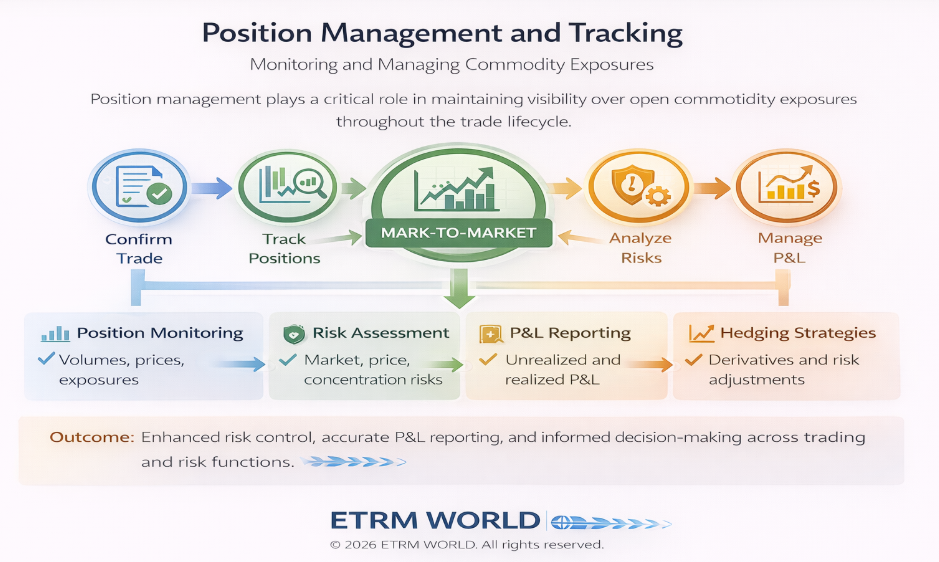
Position Management and Tracking
Real-time position volume monitoring
Price sensitivity and exposure analysis
Market price tracking and analysis
Mark-to-market valuation
© 2026 ETRM World Powerd By 3DGLOBAL. All rights reserved.
Settlement and clearing ensure that the contractual obligations of the trade are fulfilled.
For physical commodity trades, this involves coordinating logistics, delivery schedules, quality inspections, and transfer of ownership. For financial or exchange-traded commodities, clearinghouses facilitate settlement, margining, and netting of positions.
Settlement teams ensure that invoices are generated accurately, payments are processed on time, and receipts are reconciled. Any settlement discrepancies, such as quantity or quality variances, are identified and resolved through agreed contractual mechanisms.
Timely and accurate exchange of commodities and cash, with minimal settlement risk.
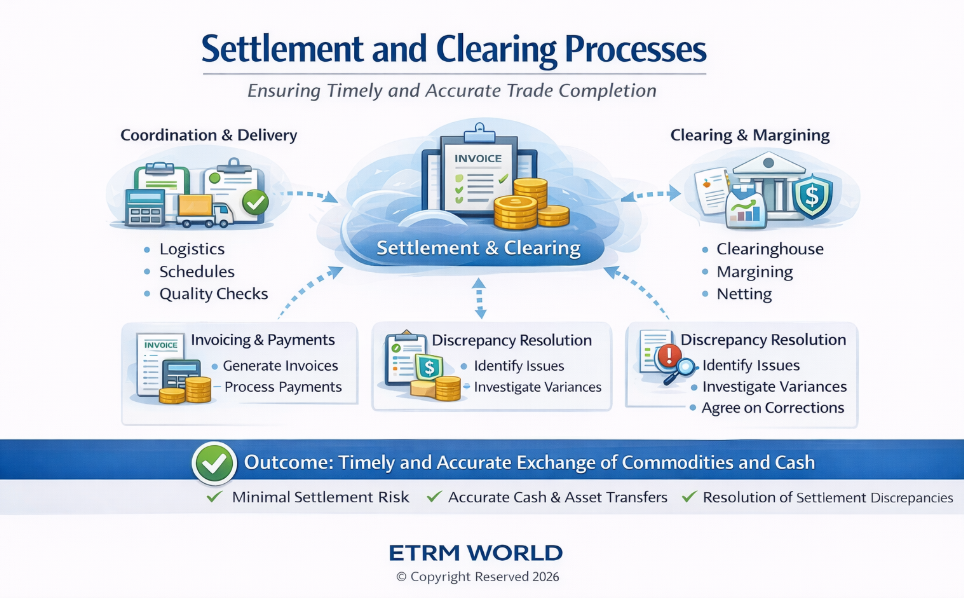
Settlement and Clearing Processes
Logistics, delivery, quality inspections
Cash settlement, netting, margining
Clearinghouse facilitation
Bilateral agreement settlement
© 2026 ETRM World Powerd By 3DGLOBAL. All rights reserved.
Best practices are applied throughout the trade lifecycle to improve efficiency and reduce operational risk.
These include standardized trade documentation, clear segregation of duties, strong internal controls, audit trails, and regular reconciliations. Continuous monitoring and exception management help identify potential issues early, while periodic reviews improve process robustness.
A resilient, well-governed trade lifecycle with reduced errors and improved compliance.
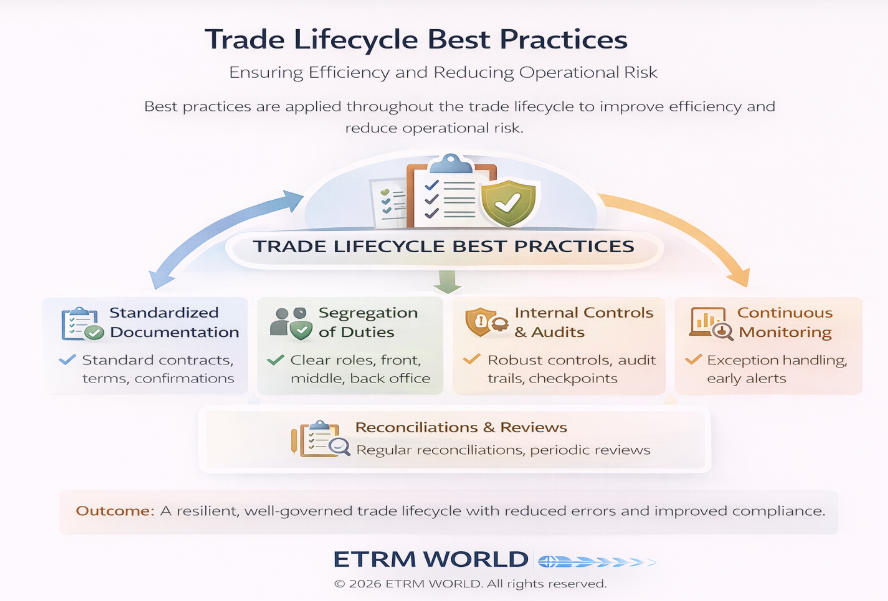
Trade Lifecycle Best Practices
Consistent trade contracts and records
Clear role separation and responsibilities
Strong control mechanisms and checks
Complete transaction tracking
© 2026 ETRM World Powerd By 3DGLOBAL. All rights reserved.
Workflow automation enhances the efficiency and reliability of the commodity trade lifecycle.
Automated systems reduce manual intervention by streamlining trade capture, confirmations, settlements, and reporting. Integration across trading, risk, operations, and finance platforms improves data accuracy and transparency. Automation also supports regulatory reporting and real-time monitoring.
Faster processing reduced operational risk, improved scalability, and better control over end-to-end trade operations.
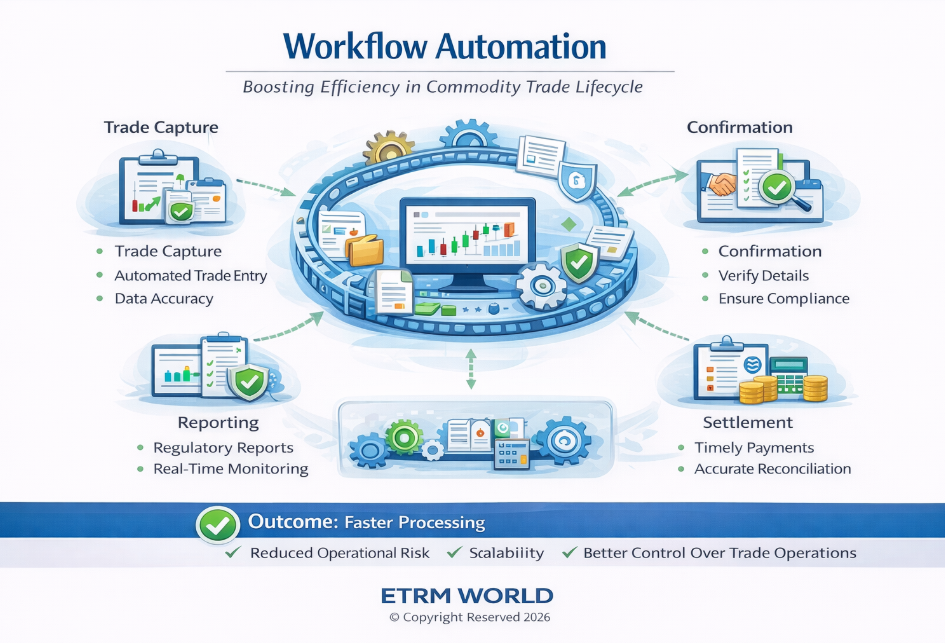
Workflow Automation
Automated trade entry and validation
Electronic trade confirmations
Automated payment processing
Automated report generation
© 2026 ETRM World Powerd By 3DGLOBAL. All rights reserved.
Position accounting defines how commodity positions are calculated, aggregated, and maintained across the trade lifecycle.
This includes the treatment of physical and financial trades, long and short positions, inventory movements, and open commitments. Different accounting approaches—such as trade-date accounting, delivery-date accounting, or net vs gross positioning—are applied based on business requirements and reporting needs. Accurate position accounting ensures consistency across trading, risk, and finance functions.
A reliable and standardized view of commodity positions across portfolios and books.
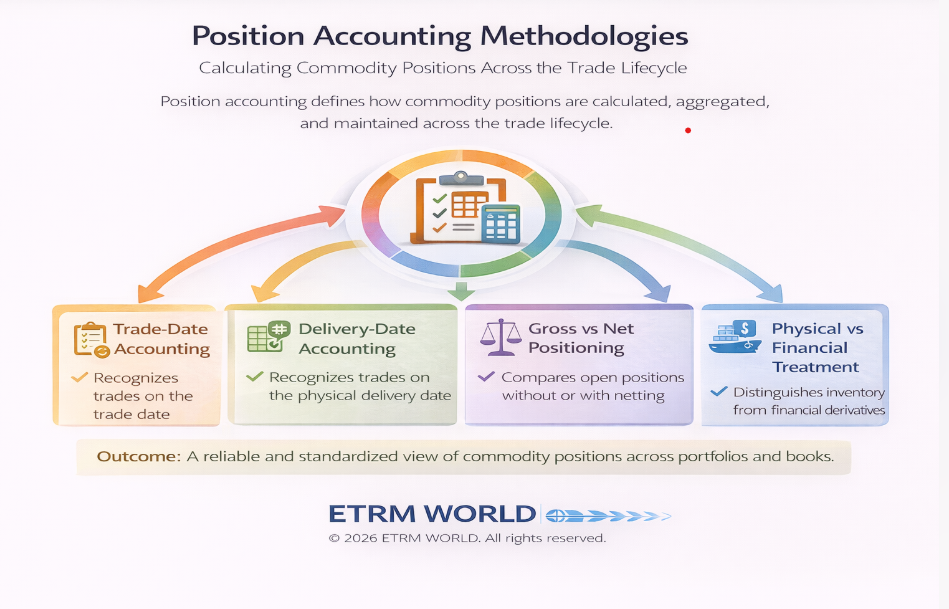
Position Accounting Methodologies
Positions recorded on trade execution date
Positions recorded on delivery date
Offsetting long and short positions
Separate long and short position tracking
© 2026 ETRM World Powerd By 3DGLOBAL. All rights reserved.
Real-time position tracking provides continuous visibility into open and closed positions as market conditions change.
As trades are executed, amended, or settled, positions are updated instantly across trading systems. This allows traders and risk managers to monitor exposure by commodity, location, counterparty, and time period. Real-time tracking supports faster decision-making and enables proactive risk management during volatile market conditions.
Immediate awareness of exposure changes and improved trading responsiveness.
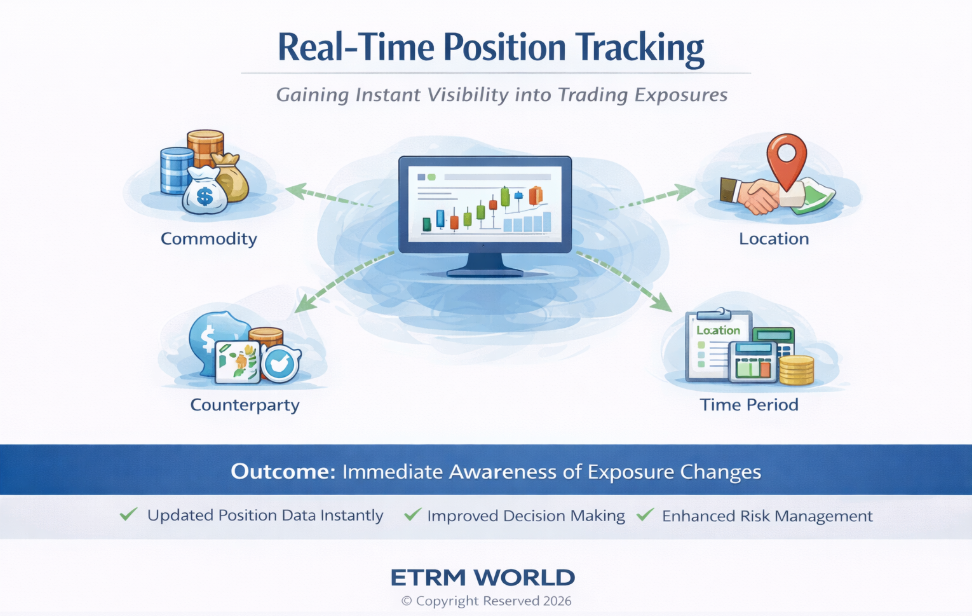
Real-time Position Tracking
Instant position updates on trade execution
Real-time position adjustments
Position closure on settlement
Continuous market data integration
© 2026 ETRM World Powerd By 3DGLOBAL. All rights reserved.
Exposure analysis focuses on identifying and measuring potential financial risk arising from market movements.
This includes price exposure, volume exposure, basis risk, and counterparty exposure. Scenario analysis and stress testing are commonly used to evaluate how positions may perform under adverse market conditions. Exposure analysis helps organizations understand risk concentrations and assess the impact of price volatility on overall portfolios.
Clear identification of risk drivers and better control over potential losses.
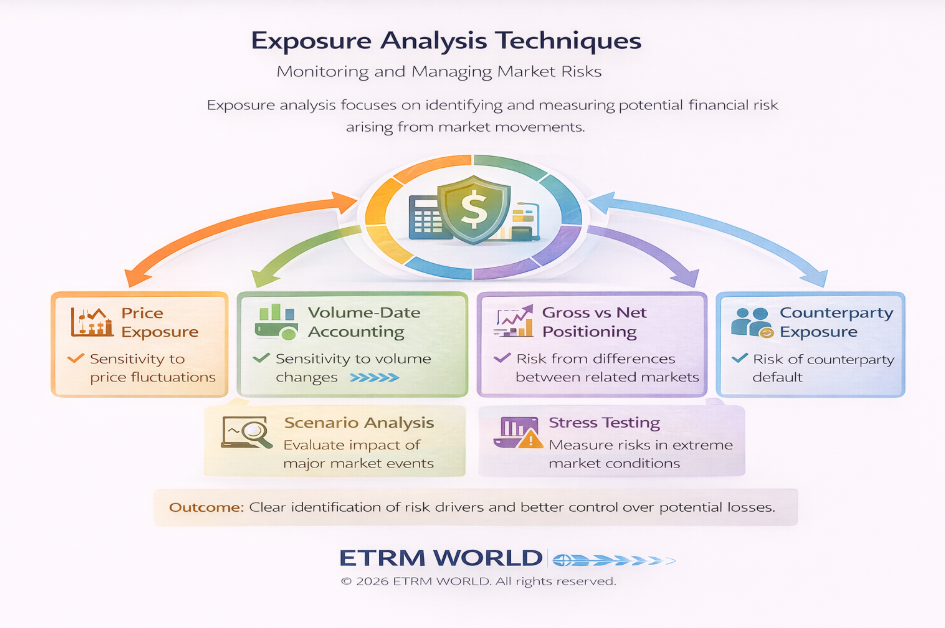
Exposure Analysis Techniques
Risk from price movements and volatility
Risk from quantity variations
Price differential between markets
Credit and default risk assessment
© 2026 ETRM World Powerd By 3DGLOBAL. All rights reserved.
Mark-to-Market (MTM) valuation measures the current value of open positions based on prevailing market prices.
Positions are revalued regularly using market curves, indices, and pricing models. MTM calculations provide both unrealized and realized Profit & Loss (P&L), offering transparency into trading performance. Accurate valuations are critical for risk assessment, financial reporting, and regulatory compliance.
Transparent and accurate valuation of trading positions and P&L.
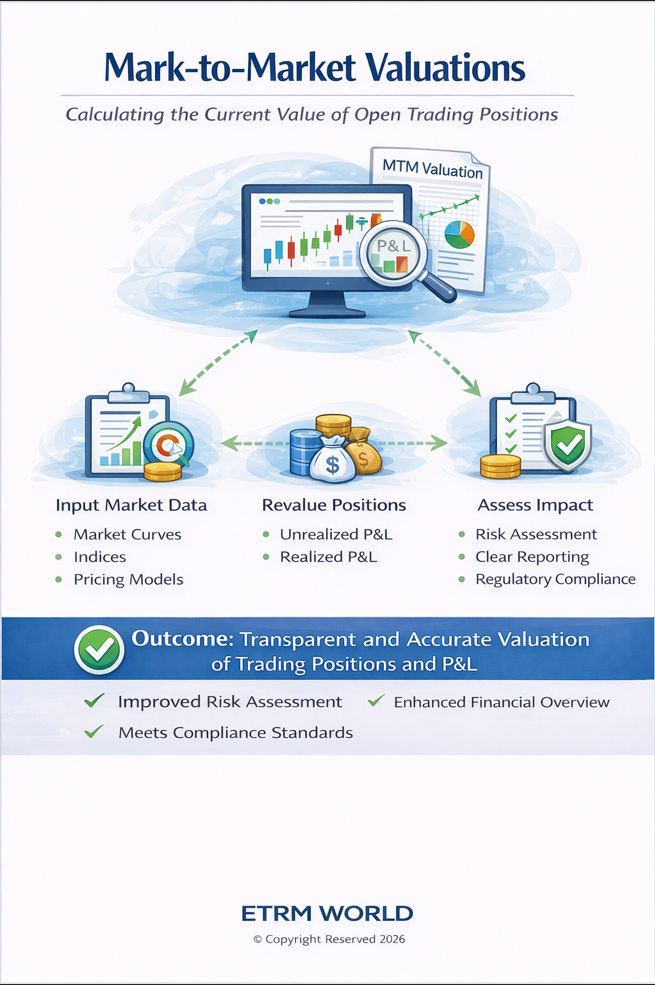
Mark-to-Market Valuations
Using forward curves for pricing
Index-based valuation methods
Advanced pricing algorithms
Periodic position updates
© 2026 ETRM World Powerd By 3DGLOBAL. All rights reserved.
Risk metrics and Key Performance Indicators (KPIs) provide quantitative insights into exposure and performance.
Common metrics include Value at Risk (VaR), position limits, stop-loss thresholds, stress test results, and credit exposure limits. KPIs help management track risk appetite, trading efficiency, and portfolio performance. Monitoring these indicators ensures that trading activities remain within approved risk frameworks.
Measurable risk oversight and stronger governance.
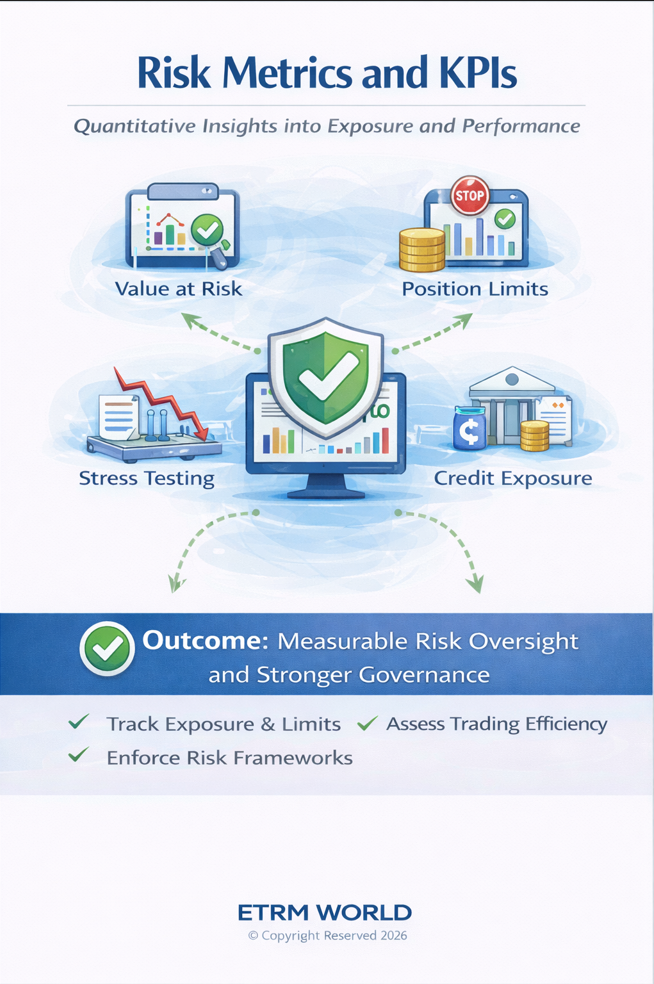
Risk Metrics and KPIs
Statistical measure of potential loss
Maximum allowed position sizes
Automatic loss prevention levels
Performance under extreme scenarios
© 2026 ETRM World Powerd By 3DGLOBAL. All rights reserved.
Position reporting transforms complex position and exposure data into actionable insights.
Reports are generated for traders, risk teams, finance, and senior management, providing views by commodity, region, portfolio, and time horizon. Automated and standardized reporting supports regulatory disclosures, internal audits, and management decision-making.
Clear, consistent, and timely visibility into positions and exposures.
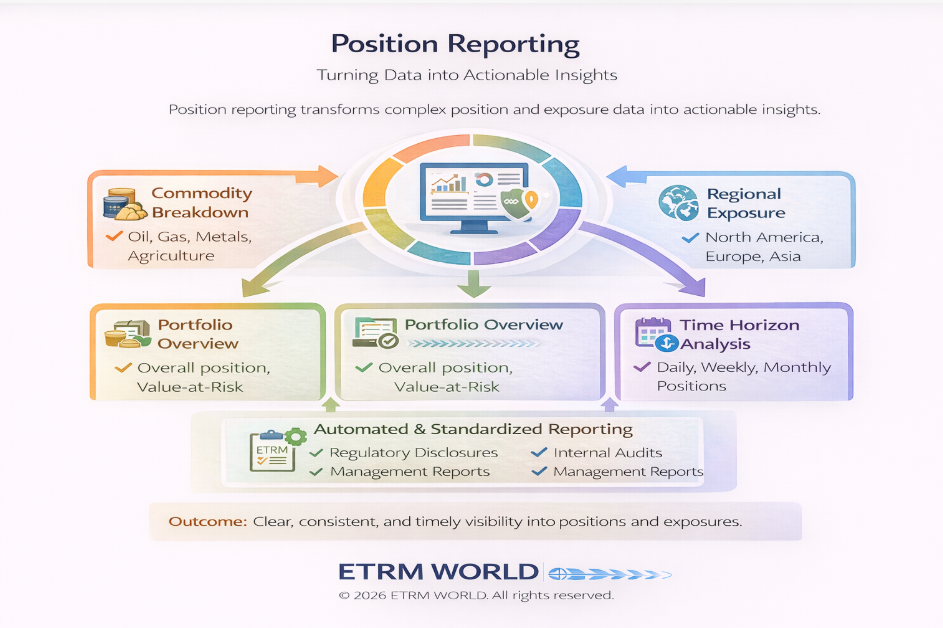
Position Reporting
Commodity-specific position views
Geographic position distribution
Portfolio-level position analysis
Temporal position perspectives
© 2026 ETRM World Powerd By 3DGLOBAL. All rights reserved.