Master the essentials of Energy Trading and Risk Management systems
An Energy Trading and Risk Management (ETRM) system is a specialized enterprise platform designed to manage the complete lifecycle of energy trading activities. Energy markets are complex due to physical delivery constraints, volatile pricing, regulatory requirements, and high financial exposure. ETRM systems exist to bring structure, control, transparency, and automation to these operations.
At a high level, an ETRM system supports activities ranging from trade execution to risk measurement and financial settlement. It acts as a single source of truth where all trading, logistics, pricing, and financial data are stored and processed.
Without an ETRM system, energy trading organizations would struggle to manage volumes, exposures, and compliance efficiently.
Used by traders and commercial teams. Includes deal capture, pricing, position tracking, and trade amendments. Speed and accuracy are critical here, as market decisions are time sensitive.
Focuses on risk management and control. Includes market risk (price exposure), credit risk (counterparty exposure), valuation (Mark-to-Market), and limit monitoring.
Manages settlement, invoicing, payments, and accounting. Ensures trades are correctly settled, revenues and costs are accurately recorded, and financial reporting aligns with accounting standards.
Connects the ETRM system to external platforms such as exchanges, market data providers, ERP systems, banks, and regulatory bodies.
By the end of this module, learners understand how ETRM systems are structured, why the architecture is critical, and how each layer supports business operations.
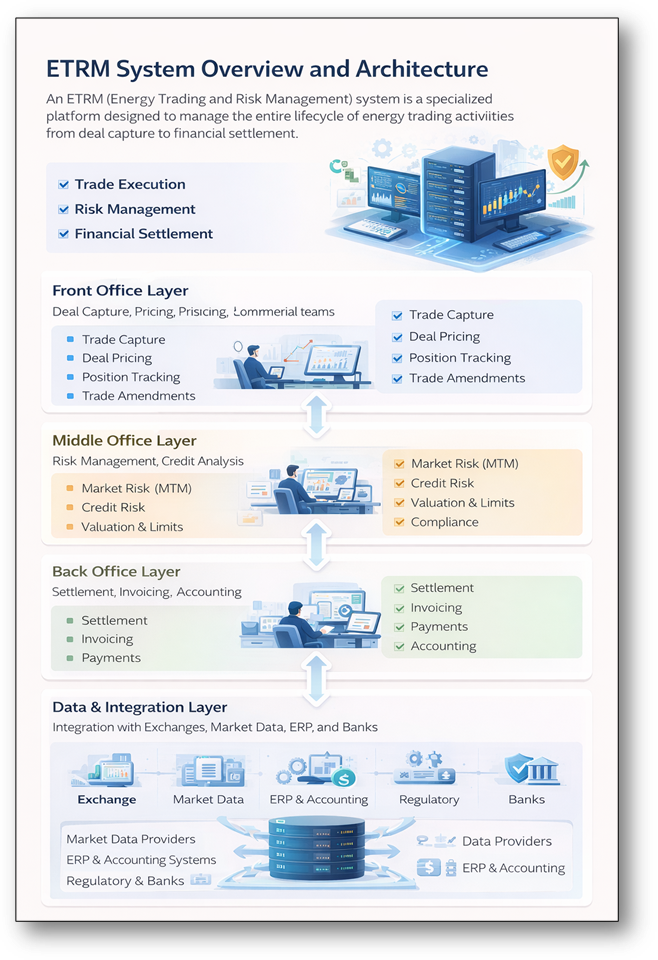
ETRM System Overview
© 2026 ETRM World Powerd By 3DGLOBAL. All rights reserved.
Energy markets differ significantly from traditional financial or commodity markets because energy is both a physical and financial product. This module builds the foundational understanding required to work effectively with ETRM systems.
Energy commodities have unique characteristics related to storage, transportation, pricing, and delivery constraints that make them fundamentally different from other commodities.
Must be consumed as it is produced, requires real-time grid balancing
Pipeline transportation, storage constraints, seasonal demand patterns
Involves liquefaction, shipping, and regasification processes
Global benchmark pricing, transportation via tankers and pipelines
Diesel, Petrol, Jet Fuel - derived from crude oil refining
Solar, Wind, Green Power - intermittent generation patterns
This module ensures learners understand how energy prices are formed, how markets function, and why energy trading requires specialized systems like ETRM.
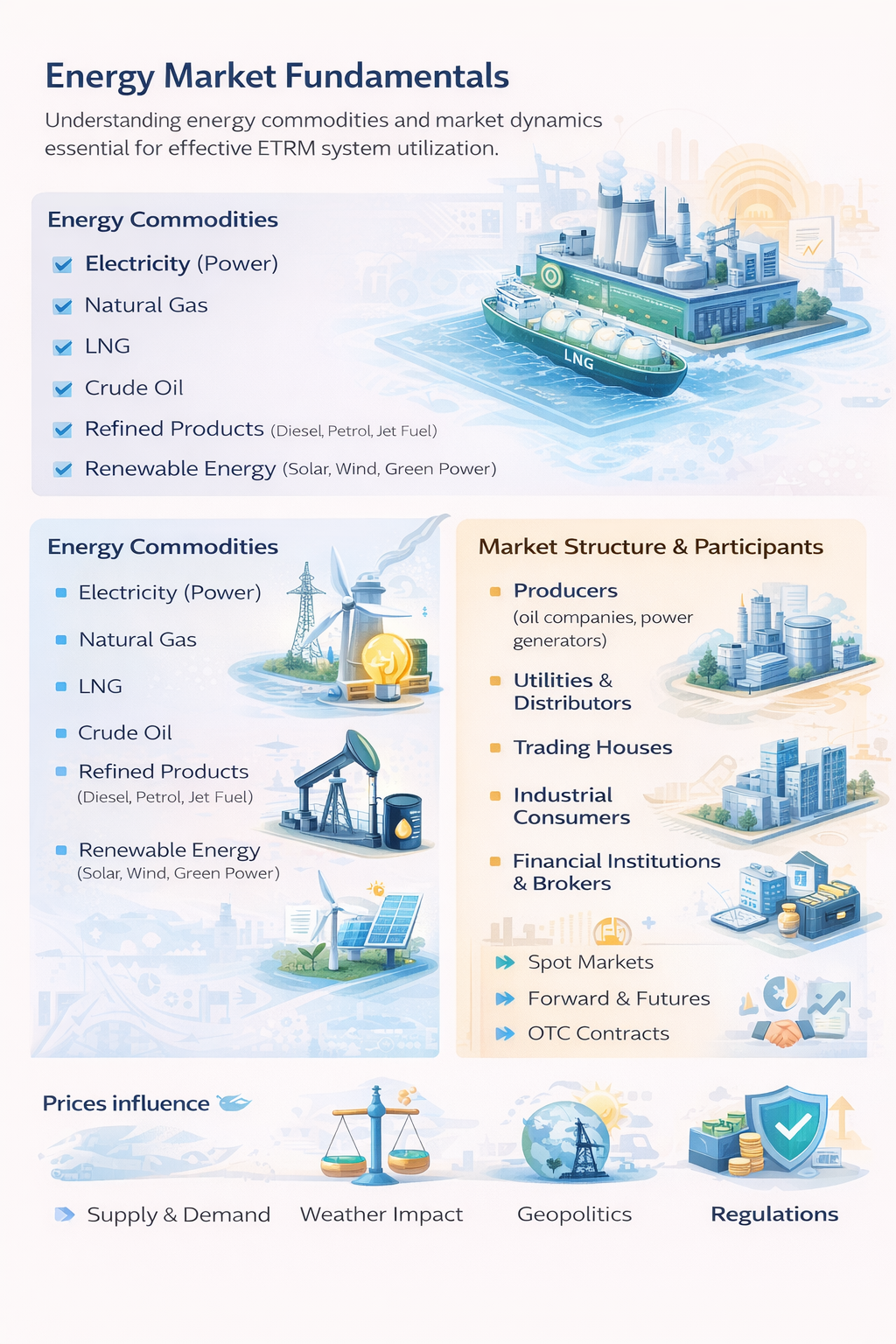
Energy Market Fundamentals
© 2026 ETRM World Powerd By 3DGLOBAL. All rights reserved.
This module explains the end-to-end lifecycle of an energy trade and how ETRM systems support each step.
ETRM systems ensure that all departments work on the same data, reducing manual errors and operational risk.
A trader identifies a market opportunity and negotiates a deal with a counterparty.
The deal is entered into the ETRM system with details such as price, volume, delivery period, location, and counterparty.
The trade is confirmed internally and externally to avoid disputes.
For physical trades, delivery schedules, pipeline nominations, or power schedules are created.
The system calculates price exposure, credit exposure, and checks against limits.
Delivered quantities are reconciled, invoices are generated, and payments are processed.
Financial postings and management reports are created.
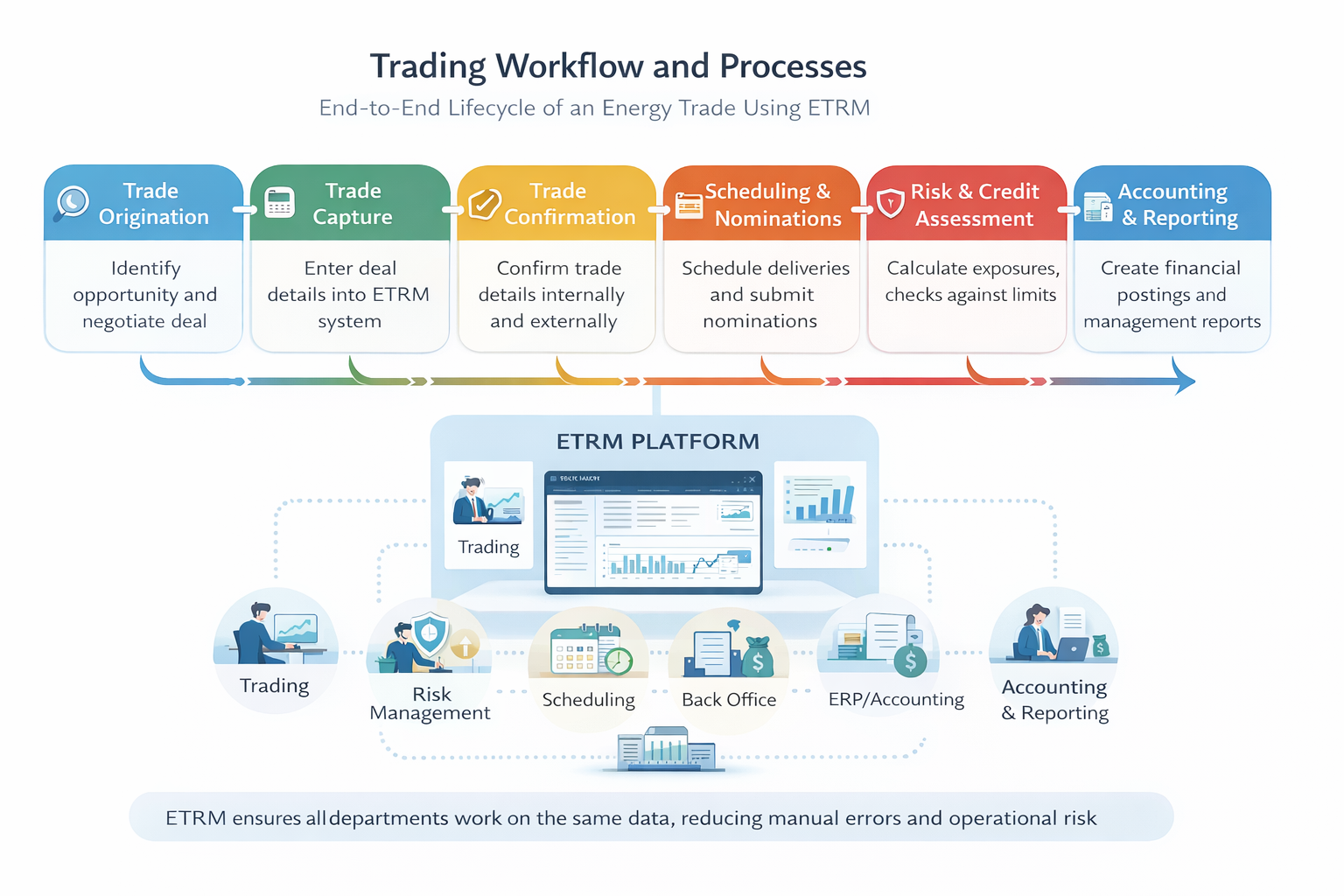
Understand how ETRM systems streamline the complete trade lifecycle from origination to settlement, ensuring efficiency and compliance throughout the process.
© 2026 ETRM World Powerd By 3DGLOBAL. All rights reserved.
An ETRM system is built as a modular platform, where each component performs a specific business function while remaining tightly integrated with other modules. This modular design allows energy trading organizations to scale operations, handle complex trade structures, and maintain data consistency across departments.
ETRM systems act as a central integration hub, connecting various external systems to ensure real-time data flow and operational efficiency.
Records all deal-related information including commodity type, price, volume, delivery period, location, counterparty, and contract terms. Supports both physical and financial trades with version control and audit trails.
Continuously calculates market value using prices and valuation curves. Supports Mark-to-Market (MTM), Value at Risk (VaR), sensitivity analysis, and stress testing for informed trading decisions.
Manages pipeline nominations, power schedules, LNG cargo movements, and inventory tracking. Ensures contracted volumes are delivered accurately while considering infrastructure constraints.
Tracks counterparty exposure in real time, compares against approved credit limits, and triggers alerts when thresholds are breached to protect from counterparty defaults.
Reconciles actual quantities with contract terms, generates invoices, tracks payments, and posts accounting entries. Integration with ERP systems ensures accurate financial reporting.
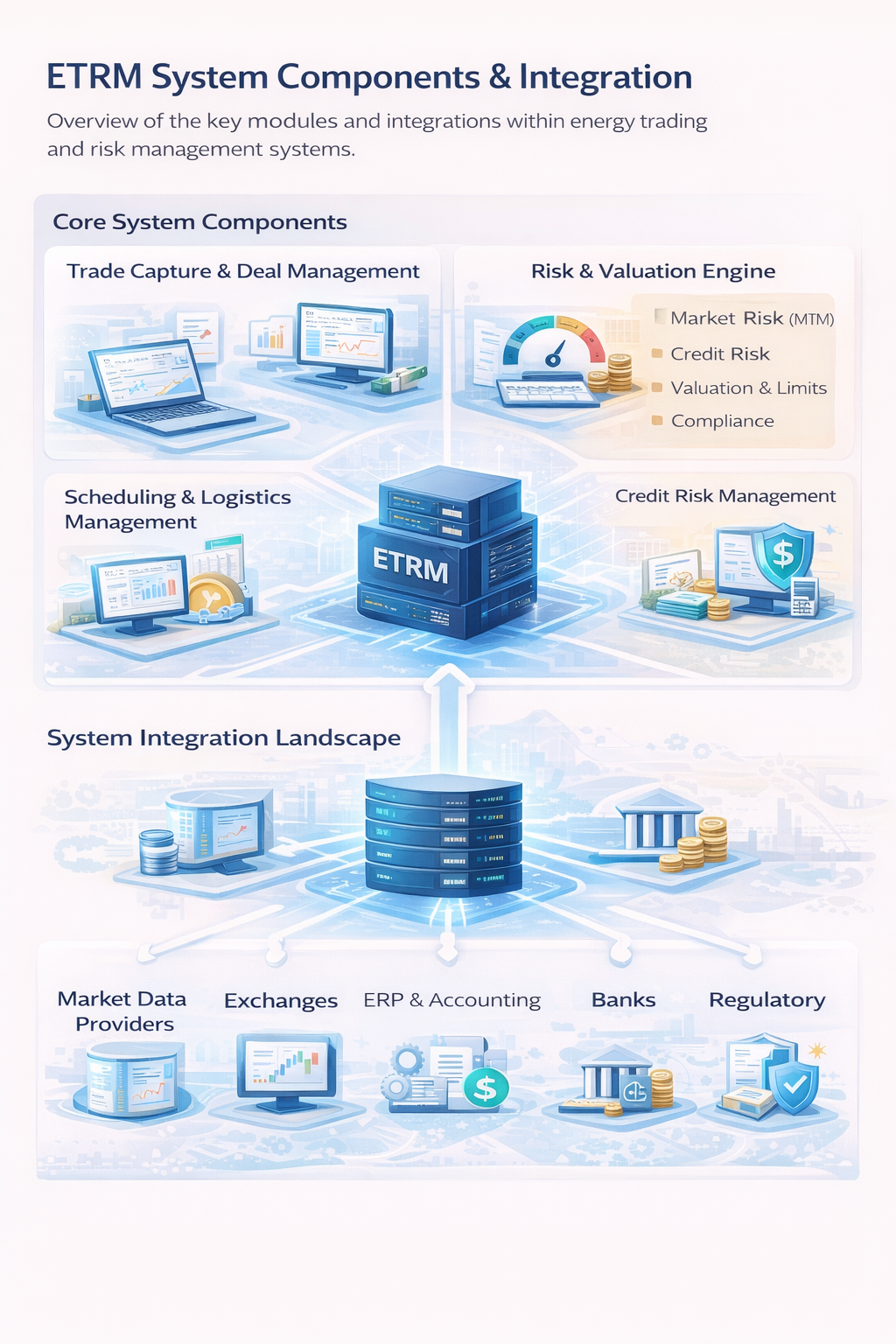
Understand how ETRM system components work together as an integrated platform to support the complete energy trading lifecycle, from trade capture to settlement and reporting.
© 2026 ETRM World Powerd By 3DGLOBAL. All rights reserved.
Energy trading involves high financial risk and strict regulatory oversight. This module focuses on governance, controls, and best practices that ensure operational excellence and compliance.
Strong governance frameworks and best practices are essential for managing risk, ensuring compliance, and maintaining stakeholder trust in energy trading operations.
Clear separation between trading, risk, and settlement teams to prevent conflicts of interest and ensure proper oversight.
Comprehensive logging of all activities and multi-level approval processes for critical operations and decisions.
Adherence to regional and global regulations including reporting requirements, position limits, and market conduct rules.
Automated validation rules, data quality checks, and reconciliation processes to ensure information integrity.
Pre-defined risk thresholds, automated alerts, and clear escalation procedures for limit breaches and exceptions.
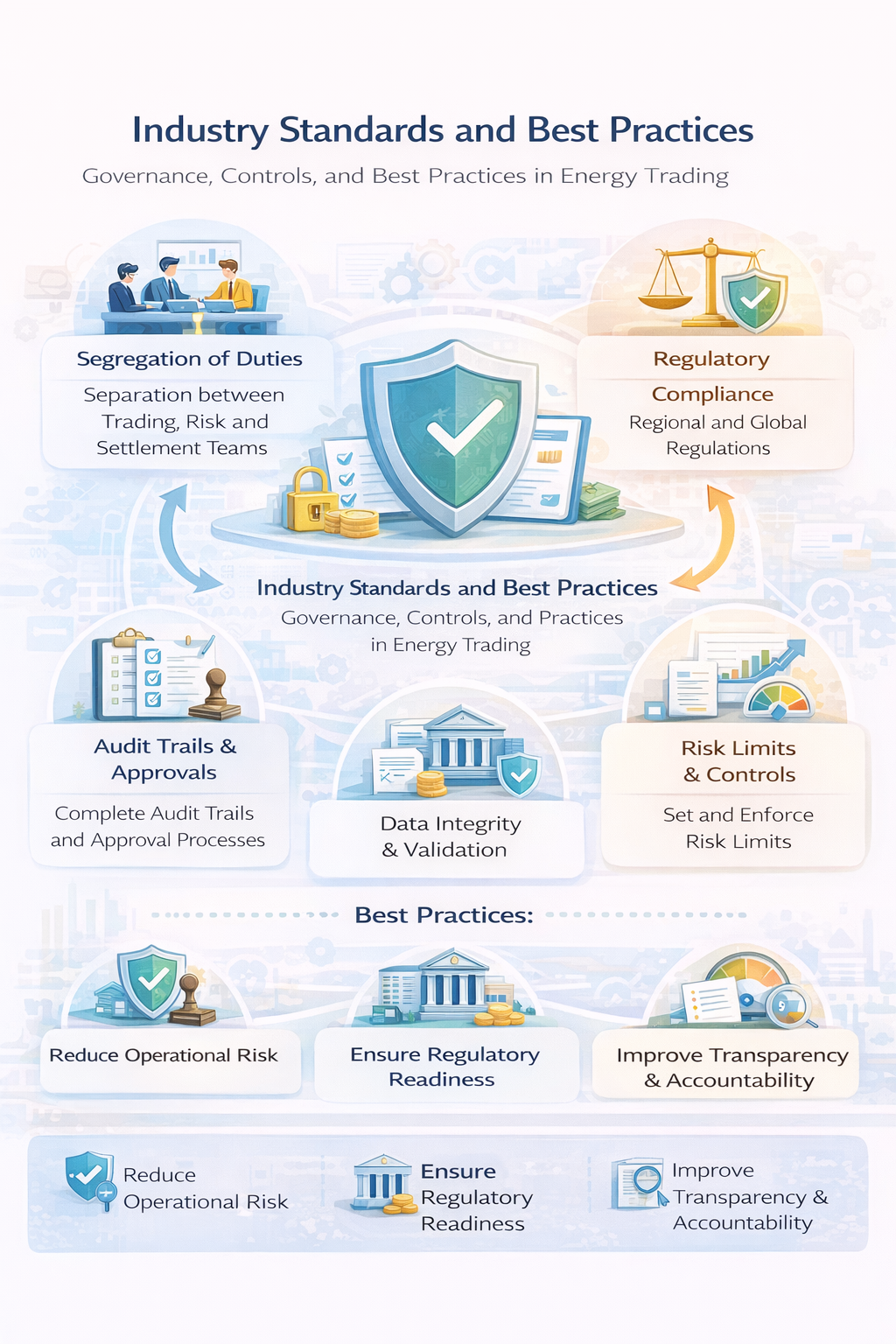
Understand how industry standards and best practices create a robust framework for energy trading operations, ensuring risk management, compliance, and operational excellence.
© 2026 ETRM World Powerd By 3DGLOBAL. All rights reserved.
While ETRM (Energy Trading and Risk Management) and CTRM (Commodity Trading and Risk Management) systems share a common goal of managing trades, risk, and settlements, their design focus and capabilities differ significantly. These differences arise mainly from the unique nature of energy commodities compared to other traded commodities.
Understanding this distinction is critical for organizations when selecting the right system and for learners aiming to work in energy trading environments.
ETRM systems are purpose-built for energy markets, where trading involves not only financial exposure but also complex physical delivery and infrastructure dependencies. Energy commodities such as power, natural gas, LNG, and oil require continuous monitoring, scheduling, and coordination with physical assets.
One of the defining features is strong support for physical delivery management. Unlike many commodities that can be stored easily, energy products often have limited storage options or none at all. For example, electricity must be consumed as it is generated, and natural gas must flow through pipelines based on capacity and nominations.
ETRM platforms provide advanced scheduling and logistics functionality. They support power scheduling across grids, gas pipeline nominations, LNG cargo scheduling, vessel movements, and storage management. These features ensure that contractual obligations are met while respecting infrastructure limitations.
ETRM systems support energy-specific instruments and compliance requirements, such as power grid operations and congestion management, gas pipeline capacity and balancing, LNG liquefaction, shipping, and regasification chains, and renewable energy certificates and environmental attributes.
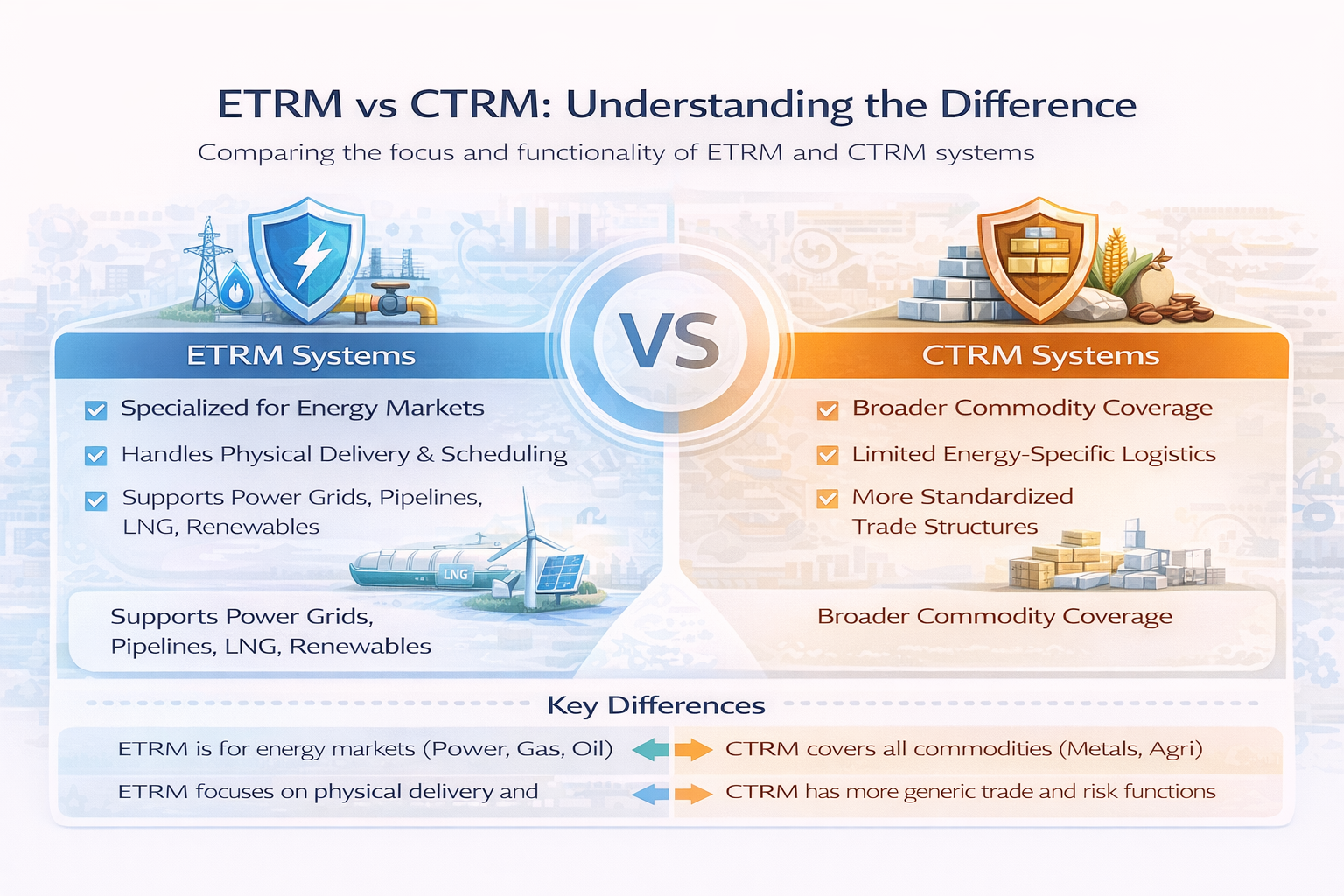
CTRM systems are designed to manage a broad range of commodities beyond energy, including metals, agricultural products, and soft commodities such as grains, sugar, and coffee. These commodities typically have simpler logistics and fewer real-time delivery constraints compared to energy products.
CTRM platforms focus on standardized trade structures and general commodity workflows. They efficiently handle contract management, pricing, hedging, risk calculation, and settlement for commodities that can be stored, transported, and delivered with relatively predictable processes.
While CTRM systems may support basic physical delivery tracking, they usually offer limited functionality for energy-specific logistics. Features such as power grid scheduling, pipeline balancing, or LNG chain management are either not available or require heavy customization.
Understand the key differences between CTRM and ETRM systems to make informed decisions about which solution best fits your organization's trading needs and regulatory requirements. CTRM systems are well-suited for organizations dealing primarily with non-energy commodities where logistics and delivery are less infrastructure dependent, while ETRM systems excel in energy markets with complex physical delivery requirements.
© 2026 ETRM World Powerd By 3DGLOBAL. All rights reserved.
Value at Risk (VaR) is one of the most widely used risk measurement techniques in energy trading. It estimates the maximum potential loss that a trading portfolio could face over a specific time period, under normal market conditions, at a given confidence level (for example, 95% or 99%).
VaR does not predict the worst possible loss but provides a statistically expected loss threshold. It's a tool for risk management, not a crystal ball for predicting extreme events.
In an ETRM system, VaR is calculated using historical price movements, volatility, and correlations between commodities. This provides a statistical foundation for risk assessment.
VaR helps organizations quantify market risk in monetary terms rather than abstract price movements, making risk more tangible and actionable for decision-makers.
VaR calculations are typically performed at 95% or 99% confidence levels, providing different perspectives on potential risk exposure based on organizational risk appetite.
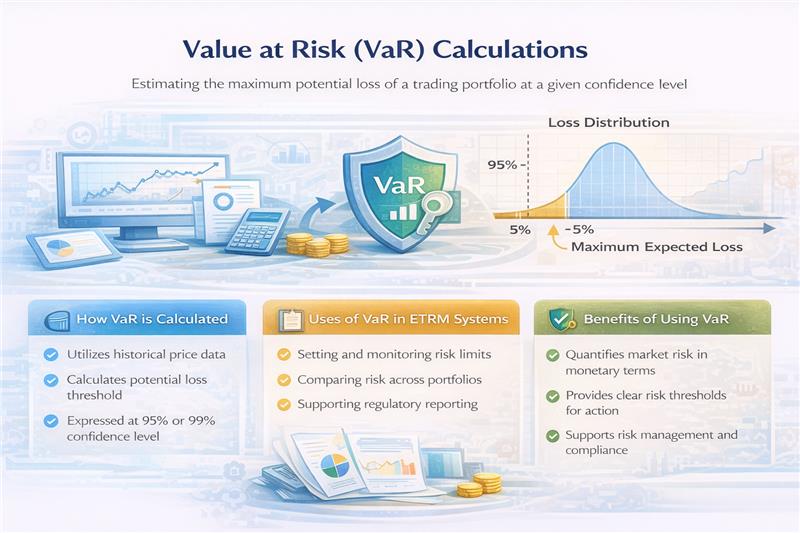
By using VaR, risk managers and senior leadership can understand how much capital is at risk due to market fluctuations and take preventive actions if limits are breached, enabling proactive risk management in volatile energy markets.
© 2026 ETRM World Powerd By 3DGLOBAL. All rights reserved.
Market risk arises from changes in commodity prices, interest rates, foreign exchange rates, and volatility. In energy markets, prices are influenced by factors such as weather conditions, supply-demand imbalances, geopolitical events, and infrastructure constraints.
Energy market risk assessment focuses on identifying and measuring how price movements impact open trading positions, requiring continuous monitoring and sophisticated analysis tools.
Changes in commodity prices directly impact trading positions. ETRM systems continuously calculate exposure using forward curves and mark-to-market valuations.
Weather significantly impacts energy demand and supply. Temperature changes affect heating and cooling needs, while weather events can disrupt production and transportation.
Political instability, trade policies, and international relations can cause sudden price movements and supply disruptions in energy markets.
Pipeline capacity, grid limitations, storage availability, and transportation bottlenecks can create regional price differences and supply constraints.
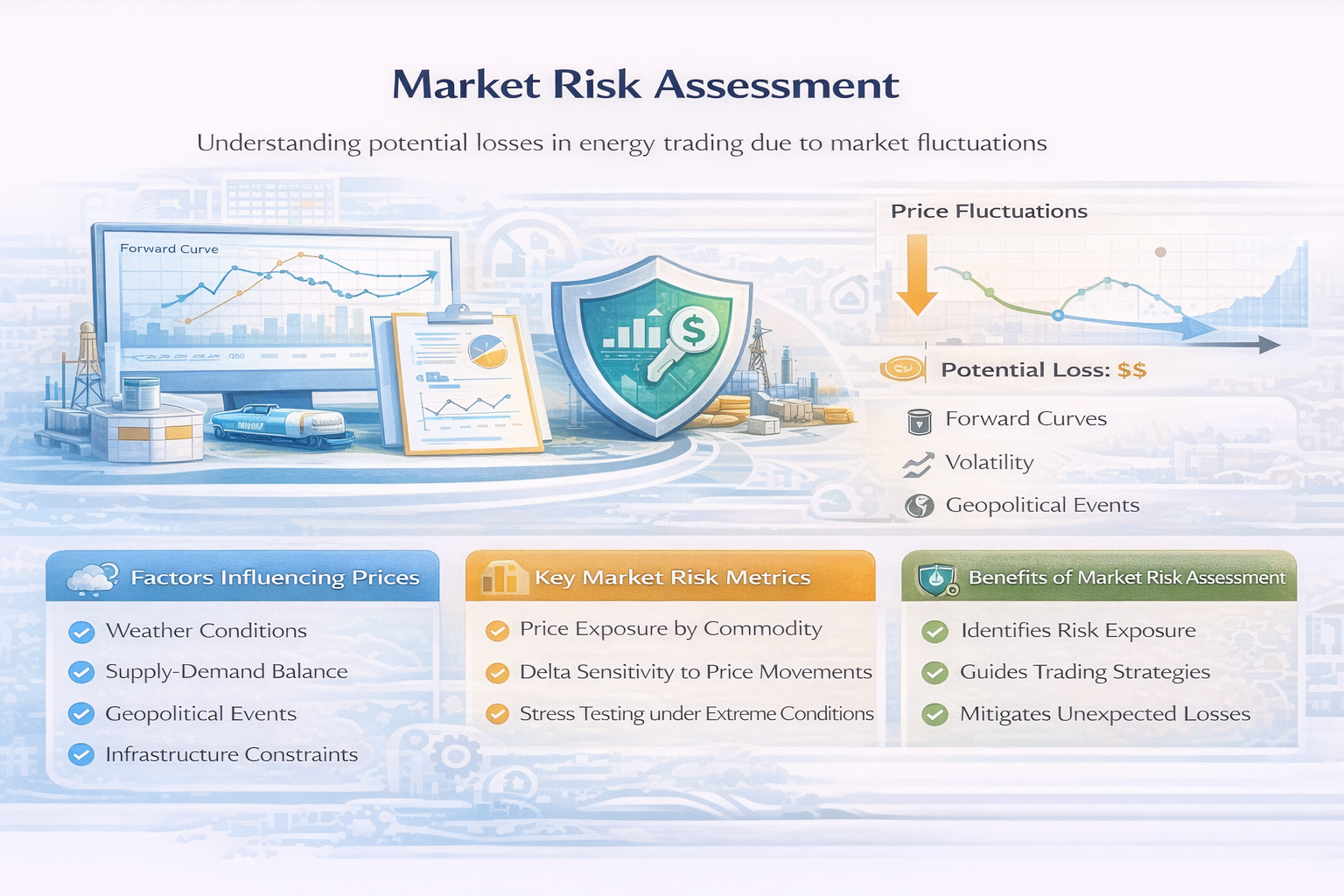
This assessment allows traders and risk teams to understand potential losses before they occur and adjust trading strategies accordingly, enabling proactive risk management in volatile energy markets.
© 2026 ETRM World Powerd By 3DGLOBAL. All rights reserved.
Credit risk refers to the risk that a counterparty may fail to fulfill its contractual obligations, such as not paying invoices or defaulting on deliveries. In energy trading, this risk is significant due to large contract values and long-term agreements.
Energy trading involves substantial financial exposure with counterparties, making effective credit risk management essential to prevent financial losses and maintain trading relationships.
ETRM systems calculate current exposure by marking all open positions to market prices, representing the immediate loss if a counterparty defaults today.
ETRM systems estimate potential future exposure using statistical models and scenario analysis to predict how exposure might change over time.
Credit limits are set by the credit or risk committee based on counterparty financial strength, trading history, and market conditions.
Long-term energy contracts create ongoing credit exposure that must be monitored throughout the contract lifecycle.
Effective credit risk management helps organizations avoid financial losses and ensures trading activities remain within approved risk boundaries, maintaining healthy trading relationships while protecting the organization's financial interests.
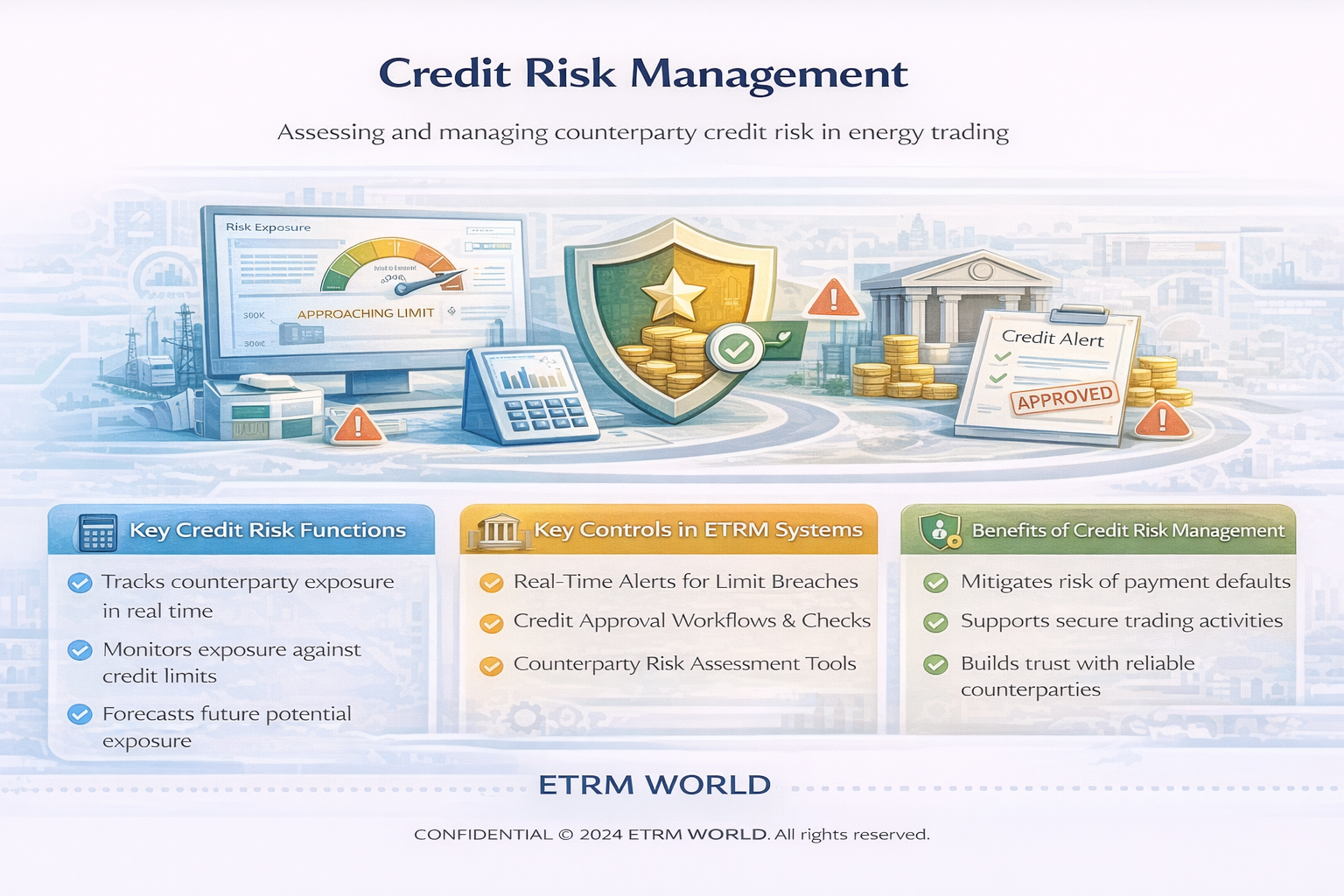
Credit Risk Management
© 2026 ETRM World Powerd By 3DGLOBAL. All rights reserved.
Effective credit risk management helps organizations avoid financial losses and ensures trading activities remain within approved risk boundaries, maintaining healthy trading relationships while protecting the organization's financial interests.
© 2026 ETRM World Powerd By 3DGLOBAL. All rights reserved.
Operational risk arises from failures in internal processes, systems, or human actions. Examples include incorrect trade entry, missing approvals, system outages, or inaccurate data.
ETRM systems reduce operational risk through built-in controls and governance mechanisms that ensure trades are captured accurately, changes are traceable, and responsibilities are clearly segregated.
Inadequate or failed internal processes, including incorrect trade entry procedures, missing approvals, or improper settlement workflows.
ETRM system outages, data corruption, integration failures, or technical issues that disrupt trading operations and data integrity.
Mistakes made by personnel, including data entry errors, incorrect calculations, unauthorized actions, or lack of proper training.
Inaccurate, incomplete, or inconsistent data that leads to incorrect valuations, reporting errors, or flawed decision-making.
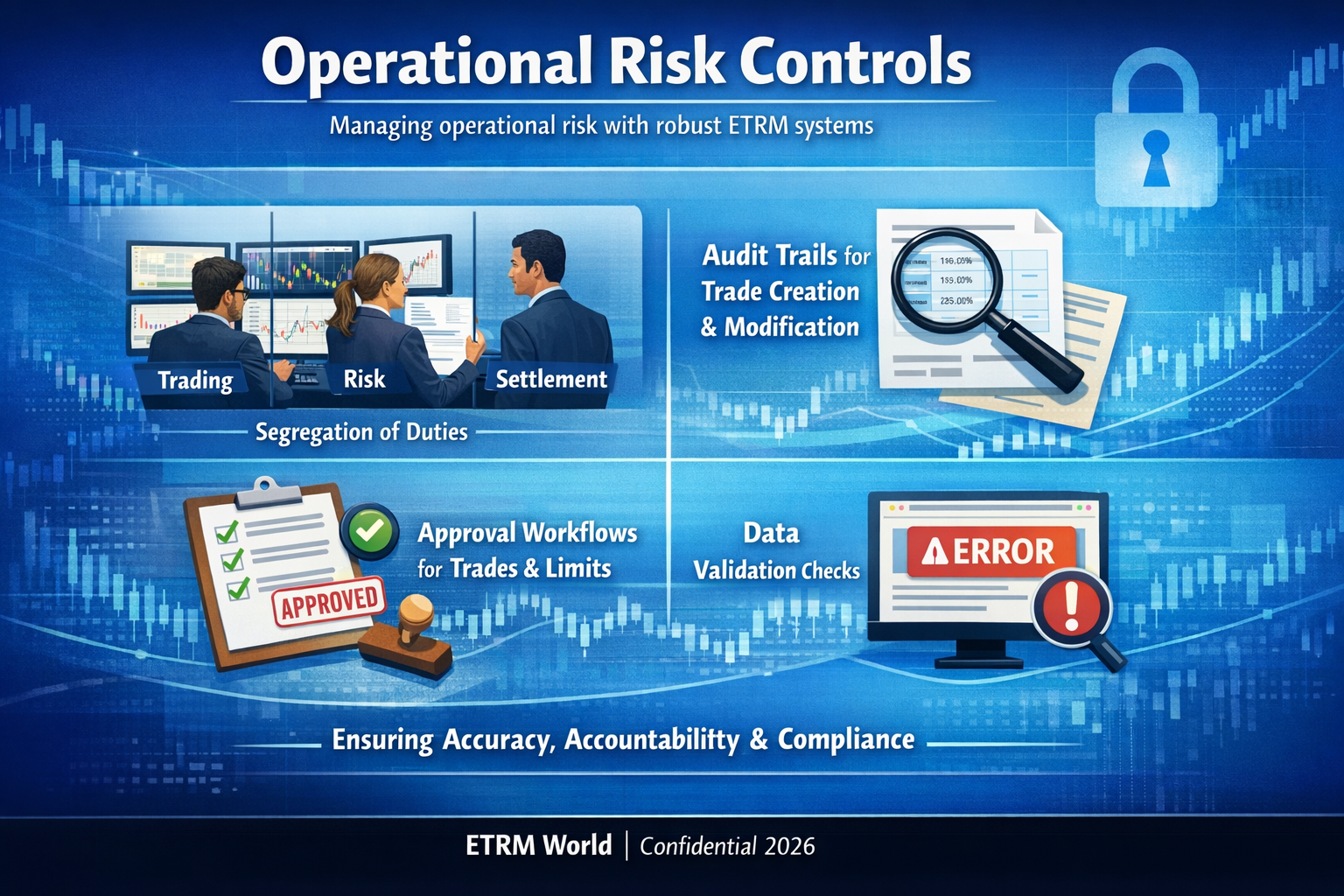
These controls help maintain data integrity, support audits, and ensure compliance with internal and external regulations, creating a robust operational risk management framework for energy trading organizations.
© 2026 ETRM World Powerd By 3DGLOBAL. All rights reserved.
Hedging is the practice of reducing price risk by taking offsetting positions in related markets or instruments. In energy trading, hedging is used to stabilize cash flows and protect margins against adverse price movements.
ETRM systems support both physical and financial hedging strategies, allowing organizations to link hedges to underlying exposures and manage volatility while operating efficiently in dynamic energy markets.
Standardized agreements to buy or sell energy commodities at a predetermined price on a specific future date, providing price certainty for future transactions.
Customized agreements between two parties to buy or sell energy commodities at a specified price on a future date, tailored to specific needs.
Financial derivatives where two parties exchange cash flows or liabilities, commonly used to convert floating-rate obligations to fixed rates.
Contracts giving the right but not obligation to buy or sell energy commodities at a specified price, providing flexibility while limiting downside risk.
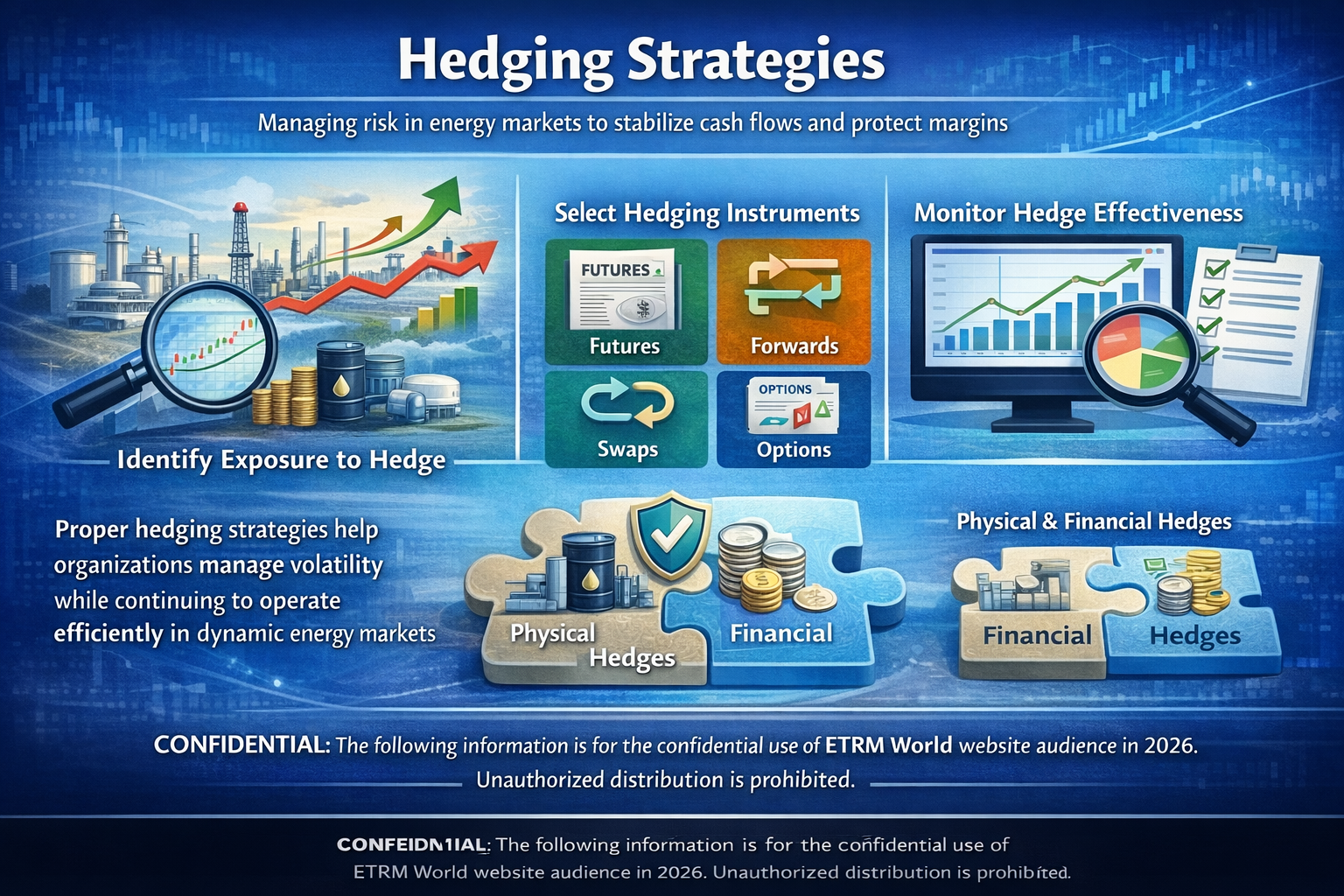
Proper hedging strategies help organizations manage volatility while continuing to operate efficiently in dynamic energy markets, providing stability and predictability for business operations.
© 2026 ETRM World Powerd By 3DGLOBAL. All rights reserved.
Risk reporting and analytics provide visibility into an organization's overall risk profile. These reports consolidate data across trading, risk, credit, and settlement functions to support informed decision-making.
ETRM systems generate standardized and ad-hoc reports that display comprehensive risk metrics, ensuring transparency, accountability, and regulatory readiness for energy trading organizations.
Comprehensive reports showing current and potential future exposure across all trading positions and counterparties, providing a complete view of risk concentrations.
Value at Risk calculations and stress testing outcomes showing potential losses under various market scenarios and extreme conditions.
Real-time monitoring of risk limits, utilization percentages, and automatic alerts when limits are approached or exceeded.
Detailed P&L analysis showing trading performance, attribution analysis, and contribution by commodity, trader, or strategy.
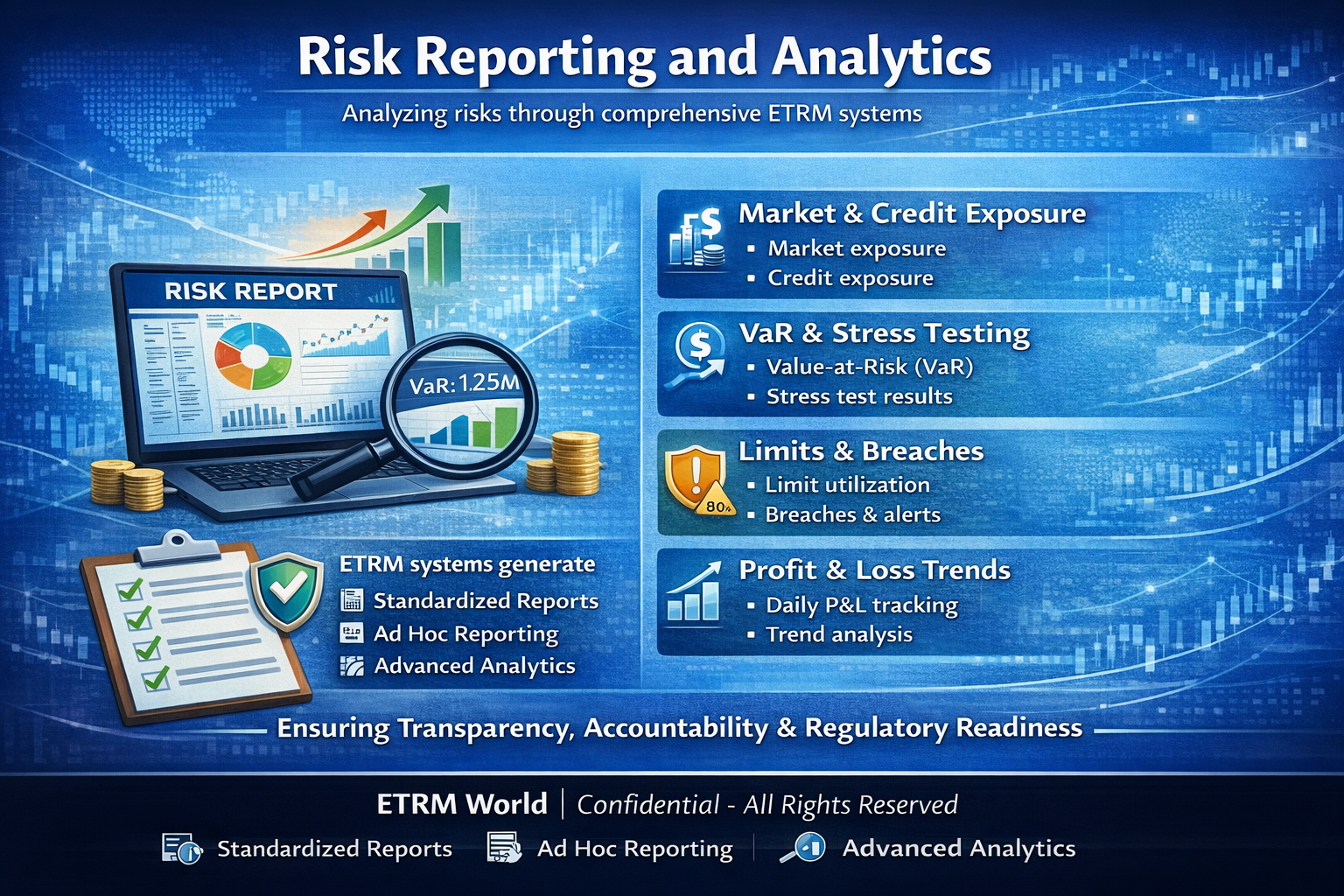
Clear and timely reporting ensures transparency, accountability, and regulatory readiness, enabling organizations to make informed decisions and maintain stakeholder confidence in volatile energy markets.
© 2026 ETRM World Powerd By 3DGLOBAL. All rights reserved.
Trade initiation is the foundational stage of the commodity trade lifecycle, where a trading opportunity is identified and formally executed.
At this stage, traders assess market conditions such as supply-demand dynamics, geopolitical factors, seasonal trends, and price volatility to make informed trading decisions.
Evaluation of current and projected supply-demand dynamics to identify trading opportunities and price trends.
Analysis of political events, trade policies, and international relations that may impact commodity markets.
Consideration of seasonal patterns and weather impacts on commodity demand and supply.
Assessment of market volatility and risk factors to determine optimal entry and exit points.
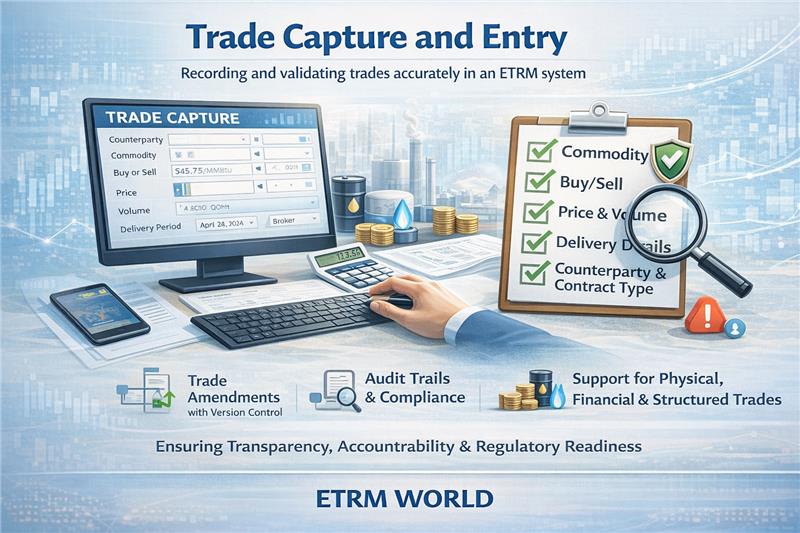
A valid trade is executed and accurately recorded in trading systems, forming the basis for all subsequent processes. Accurate and timely trade capture is essential, as errors at this stage can lead to downstream operational issues, financial losses, or compliance breaches.
© 2026 ETRM World Powerd By 3DGLOBAL. All rights reserved.
Position management plays a critical role in maintaining visibility over open commodity exposures throughout the trade lifecycle.
Once a trade is confirmed, it contributes to the firm's overall trading position. Positions are continuously monitored to track volumes, market exposure, and price movements.
Continuous monitoring of trading volumes across different commodities, locations, and time periods to maintain accurate position records.
Real-time assessment of market exposure levels and potential risks associated with open positions and market movements.
Tracking of price fluctuations and their impact on position values, enabling timely decision-making and risk management.
Regular valuation of positions using current market prices to calculate unrealized and realized P&L accurately.
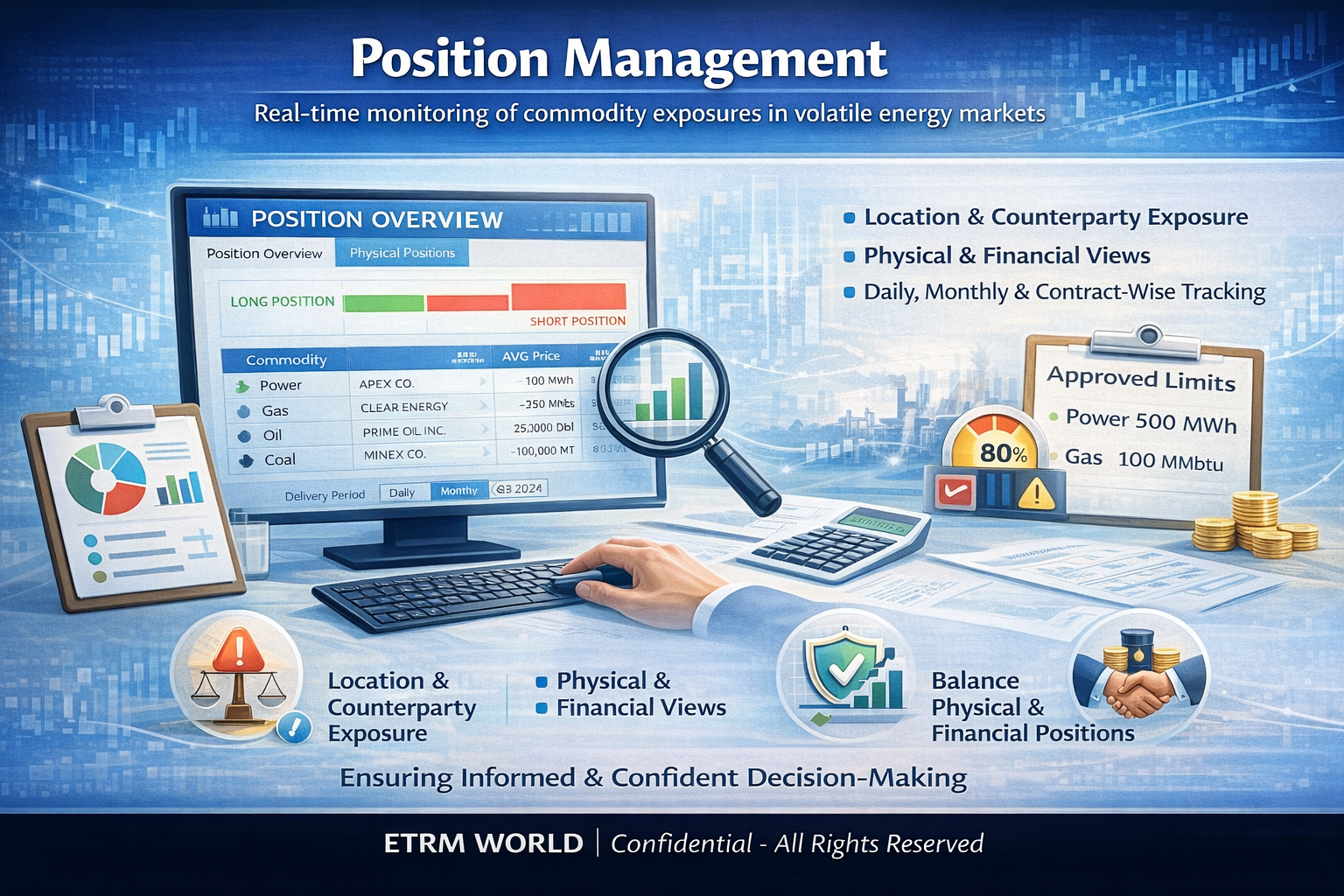
Enhanced risk control, accurate P&L reporting, and informed decision-making across trading and risk functions. Traders may hedge positions using derivatives or adjust strategies in response to changing market conditions.
© 2026 ETRM World Powerd By 3DGLOBAL. All rights reserved.
Settlement and clearing ensure that the contractual obligations of the trade are fulfilled.
For physical commodity trades, this involves coordinating logistics, delivery schedules, quality inspections, and transfer of ownership. For financial or exchange-traded commodities, clearinghouses facilitate settlement, margining, and netting of positions.
Coordination of logistics, delivery schedules, quality inspections, and transfer of ownership for physical commodity transactions.
Facilitation of settlement, margining, and netting of positions for financial or exchange-traded commodities through centralized clearing.
Accurate generation of invoices based on trade terms, quantities, and agreed pricing mechanisms for timely payment processing.
Timely processing of payments and reconciliation of receipts to ensure complete financial settlement of transactions.
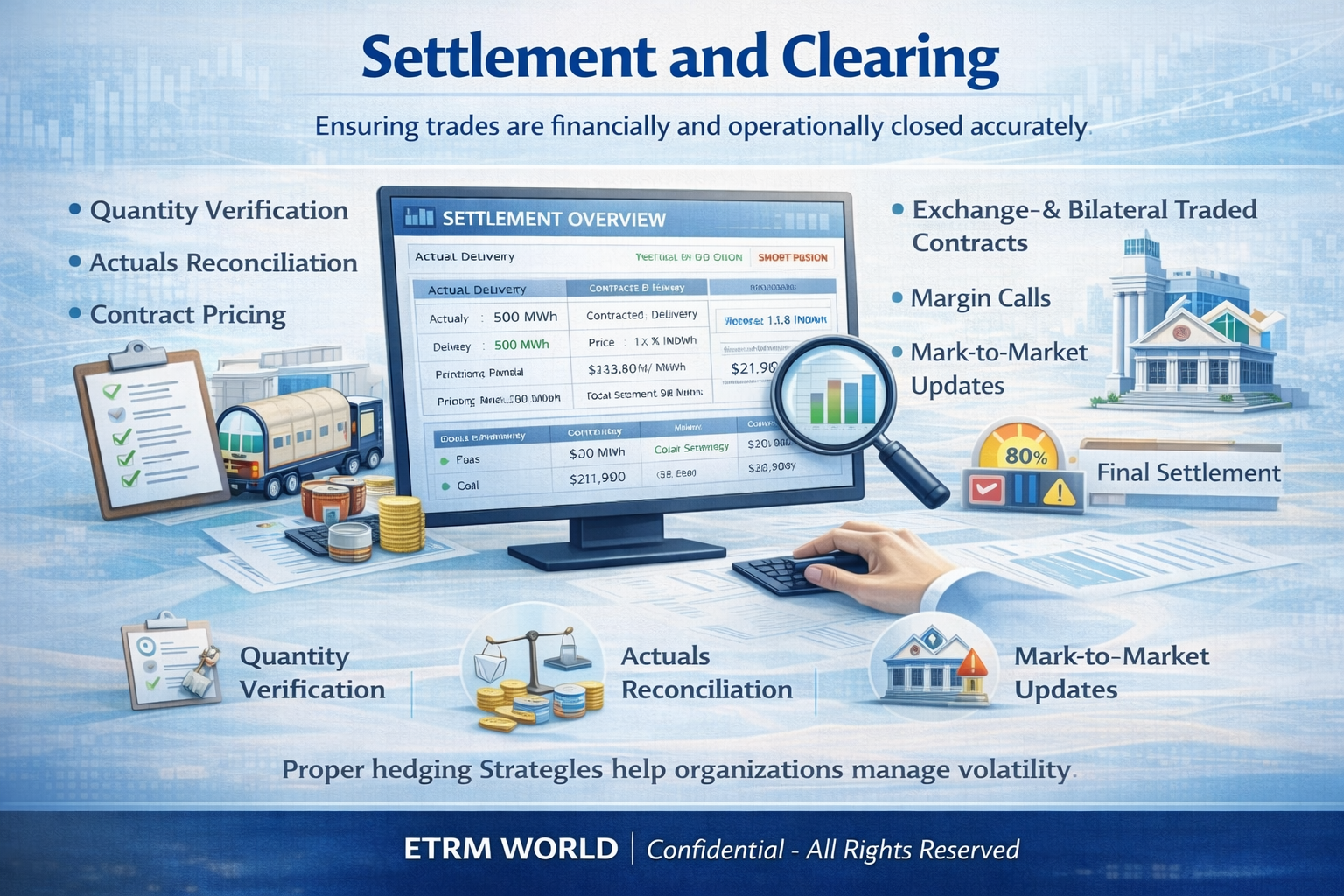
Timely and accurate exchange of commodities and cash, with minimal settlement risk. Settlement teams ensure that invoices are generated accurately, payments are processed on time, and receipts are reconciled.
© 2026 ETRM World Powerd By 3DGLOBAL. All rights reserved.
In energy trading, physical delivery is as important as the trade itself. The Logistics and Scheduling module manage how energy moves from seller to buyer.
By integrating with transmission operators, terminals, and storage facilities, this module ensures smooth execution of physical trades and avoids imbalance penalties.
Management of gas pipeline capacity nominations and scheduling to ensure contracted volumes are delivered through available pipeline infrastructure.
Creation and management of electricity delivery schedules and load profiles to match supply and demand requirements.
Comprehensive planning of LNG cargo movements and real-time tracking of vessel positions for timely delivery.
Management of storage facility operations including injection and withdrawal schedules to optimize inventory levels.
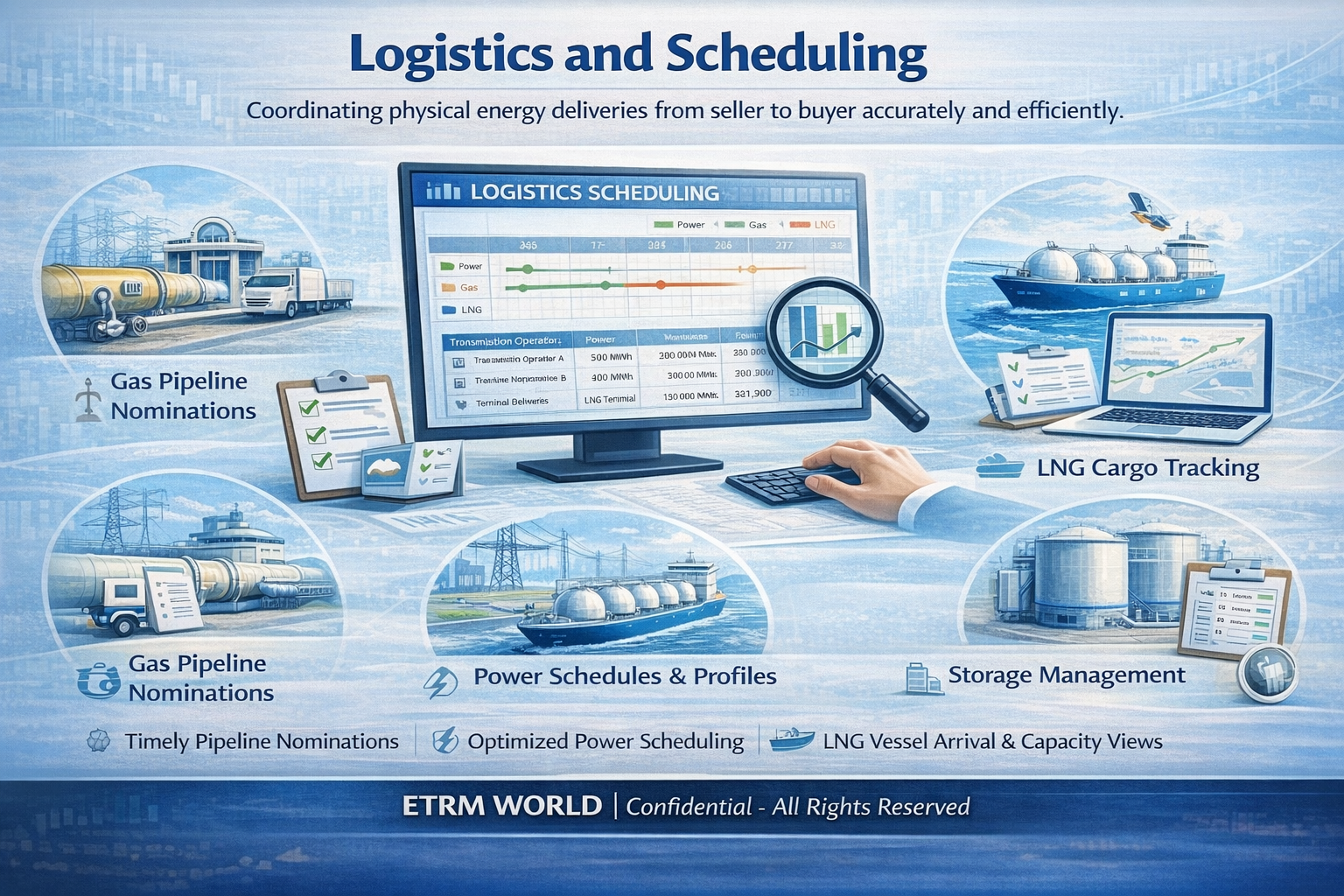
Seamless integration with transmission operators, terminals, and storage facilities ensures smooth execution of physical trades, maintains accurate inventory balances, and prevents costly imbalance penalties.
© 2026 ETRM World Powerd By 3DGLOBAL. All rights reserved.
Invoice Generation converts settled trades into financial documents sent to counterparties.
Automated invoice generation ensures faster billing cycles, reduced disputes, and accurate revenue recognition while maintaining a complete audit trail for finance and compliance teams.
Automatically generates invoices based on settlement data, ensuring accurate financial documentation for all settled trades.
Automatically applies taxes, fees, and regulatory charges according to jurisdictional requirements and contract terms.
Supports both provisional invoices for early billing and final invoices for complete settlement reconciliation.
Handles multi-currency invoicing with automatic currency conversion and international payment processing capabilities.
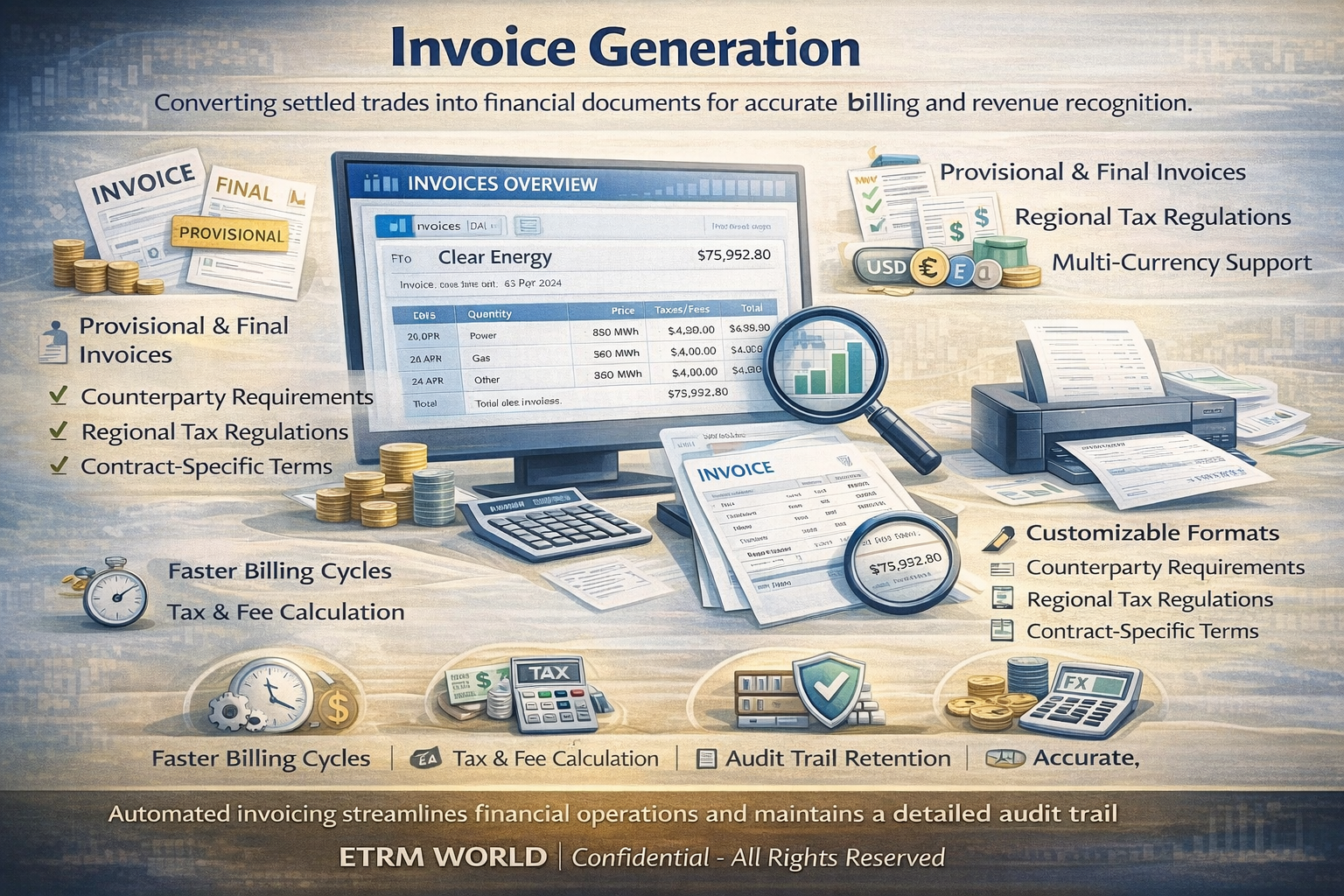
Faster billing cycles, reduced disputes, and accurate revenue recognition. The system maintains a complete audit trail for finance and compliance teams, ensuring transparency and regulatory compliance.
© 2026 ETRM World Powerd By 3DGLOBAL. All rights reserved.
Compliance and Reporting ensure that trading operations meet internal policies and external regulatory requirements.
Strong compliance and reporting capabilities ensure transparency and accountability, reduced regulatory risk, and always audit readiness for energy trading organizations.
Supports comprehensive regulatory reporting including EMIR, REMIT, Dodd-Frank, and other jurisdiction-specific requirements.
Continuous monitoring of trading activities to detect potential market abuse, manipulation, or compliance violations.
Comprehensive internal audit reporting to ensure adherence to internal policies and procedures.
Executive-level reporting providing comprehensive insights into trading operations, risk exposure, and compliance status.
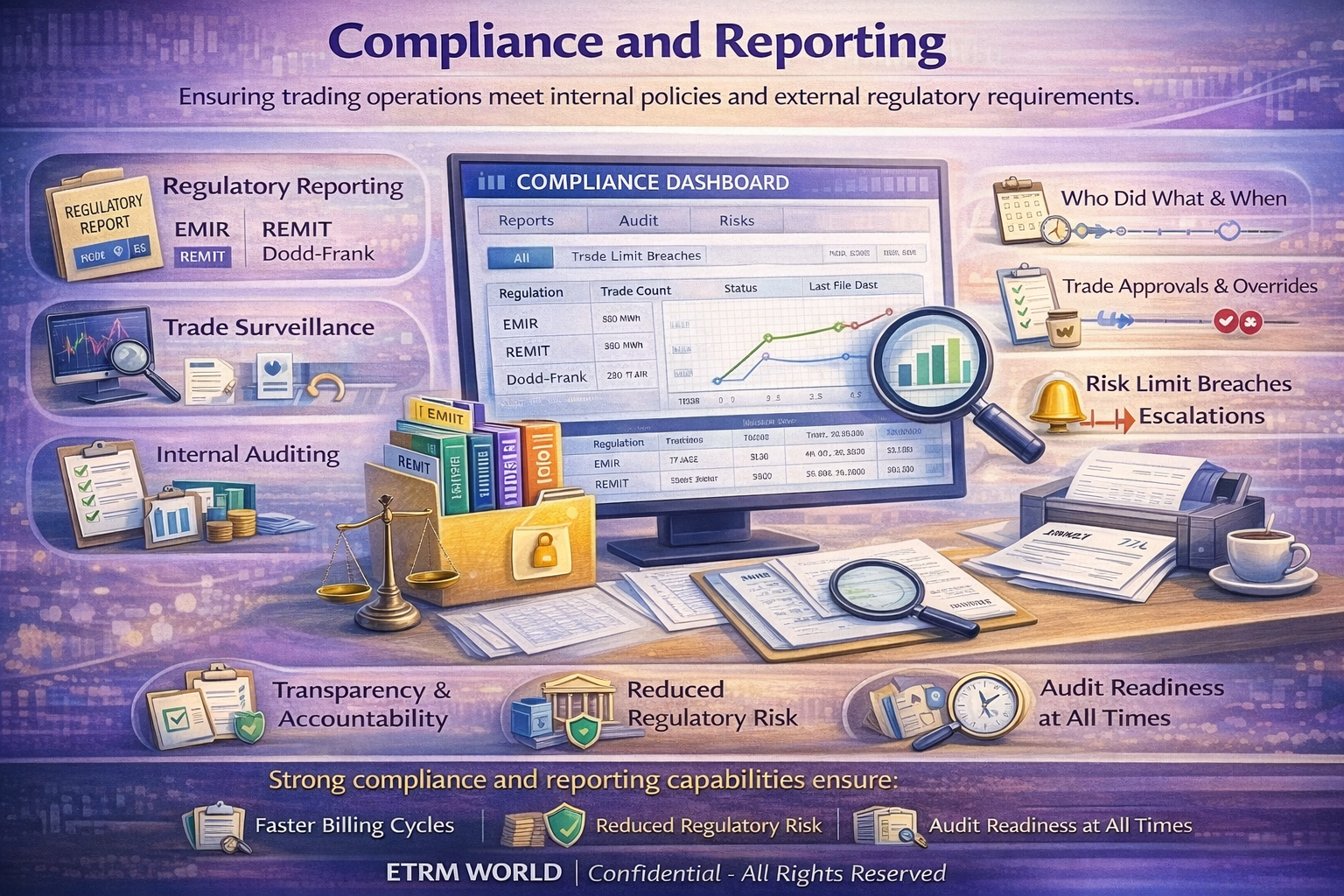
Transparency and accountability across all trading operations, reduced regulatory risk through automated compliance monitoring, and always audit readiness with comprehensive reporting capabilities.
© 2026 ETRM World Powerd By 3DGLOBAL. All rights reserved.
Understanding Energy Trading and Risk Management Systems
ETRM (Energy Trading and Risk Management) systems are comprehensive software platforms designed to manage the entire energy trading lifecycle, from trade capture to risk management and settlement.
Modern ETRM systems handle multiple energy commodities including crude oil, natural gas, electricity, and refined products, providing real-time visibility into trading positions and risk exposure.
Essential Risk Management Concepts and Strategies
Risk management is the cornerstone of successful energy trading. ETRM systems provide sophisticated tools to identify, measure, and mitigate various types of risks in energy trading operations.
Effective risk management requires real-time data, accurate modeling, and robust controls. Modern ETRM systems automate many risk management processes while providing manual oversight capabilities.
Complete Trading Workflow and Operations Management
Trading operations encompass the entire lifecycle of energy trades, from initial trade capture through final settlement. ETRM systems streamline these processes to ensure accuracy, efficiency, and compliance.
Successful trading operations require seamless integration between front, middle, and back office functions. Modern ETRM systems provide this integration while maintaining proper segregation of duties.